
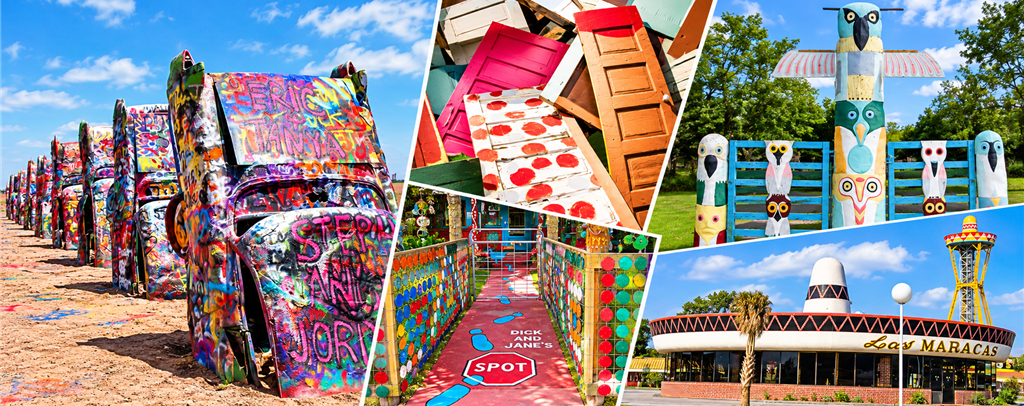
Some roadside attractions try to blend into the landscape. These eight seem determined to use every color available. Painted cars rise from dirt, giant figures glitter with glass, and a private home has become a riot of reflectors and found-object art.
These are some of the most colorful roadside attractions in America for travelers who enjoy a little visual overload. Bring a camera, but leave time to look closely: the best details are often smaller than the spectacle that made you pull over.
1. Cadillac Ranch
Amarillo, Texas
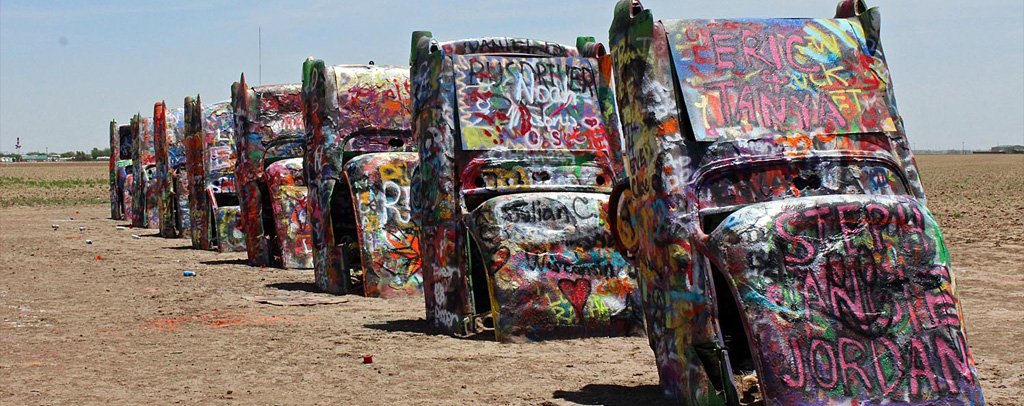
Ten Cadillacs stand nose-first in a field, their tail fins pointing skyward beneath layer after layer of spray paint. Cadillac Ranch has been a roadside landmark since 1974, but its colors refuse to stay put. Fresh names, patterns, and designs constantly cover yesterday’s work.
Created by the art collective Ant Farm, the installation turns old automobiles into a changing communal canvas. Visit for free, expect mud after rain, and carry out any cans or litter you bring. A photo records one moment in a paint job that never really ends.
Explore Cadillac Ranch in the Oddities Directory.
2. International Car Forest of the Last Church
Goldfield, Nevada
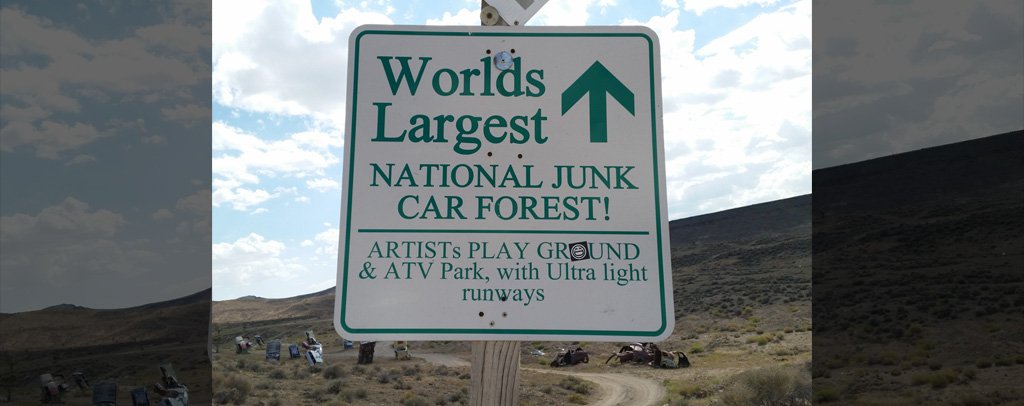
The International Car Forest has no leaves to admire. Instead, more than forty cars, vans, trucks, and buses stand planted in the desert or stacked at startling angles, their painted surfaces supplying the color. Against the open Nevada landscape, the collection is difficult to mistake for an ordinary scrapyard.
Mark Rippie began the project, with artists including Chad Sorg helping it grow. Commissioned artwork continues to change the vehicles. Walk through this free outdoor attraction in daylight, but leave your own paint at home: the stewards ask visitors not to tag the cars or damage windows.
Explore International Car Forest of the Last Church in the Oddities Directory.
3. The Heidelberg Project
Detroit, Michigan
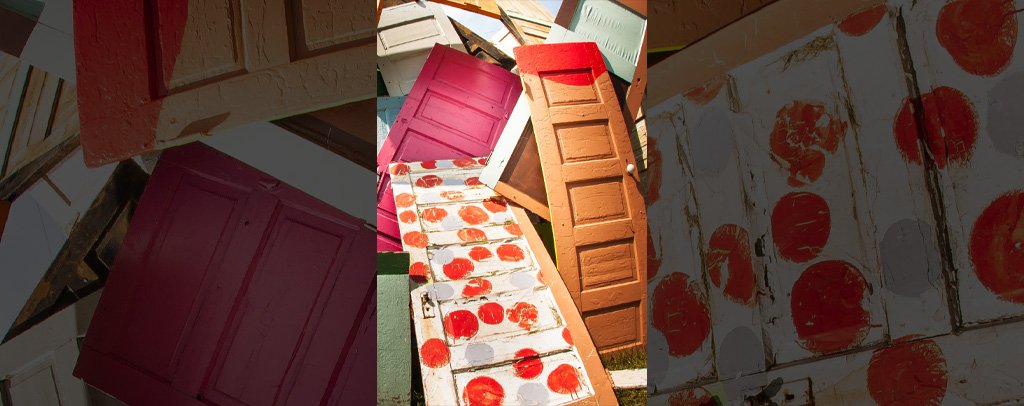
Polka dots, painted surfaces, and everyday objects turn Heidelberg Street into an outdoor art environment with an unmistakable personality. Tyree Guyton began the Heidelberg Project in 1986, using discarded material and neighborhood buildings to make art directly from the place around him.
Clocks, shoes, records, and stuffed animals have all become parts of the work. Installations change, disappear, and return, so the collection is never completely fixed. Visit during posted daytime hours, stay on public paths, and respect residents. This colorful destination is also a living neighborhood.
Explore The Heidelberg Project in the Oddities Directory.
4. Dick and Jane’s Spot
Ellensburg, Washington
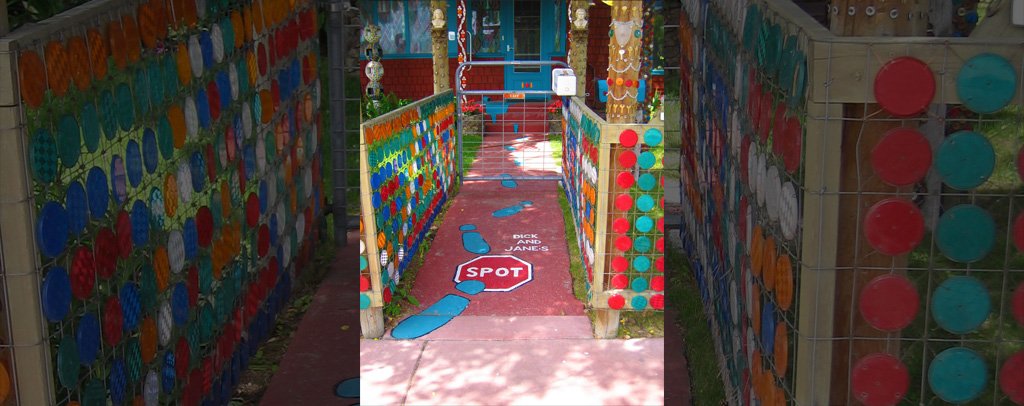
At Dick and Jane’s Spot, the temptation is to keep looking for a surface that has escaped decoration. Reflectors, bottle caps, mosaics, bicycle wheels, carved figures, and painted objects crowd the house’s exterior and yard. Thousands of reflectors add flashes of light to an already exuberant scene.
Dick Elliott and Jane Orleman began developing the property after buying it in 1978, and work by dozens of artists joined the display. It remains a private residence. Enjoy the free view from the sidewalk and outside the fence; there is plenty to study without stepping into the yard.
Explore Dick and Jane’s Spot in the Oddities Directory.
5. Ed Galloway’s Totem Pole Park
Chelsea, Oklahoma
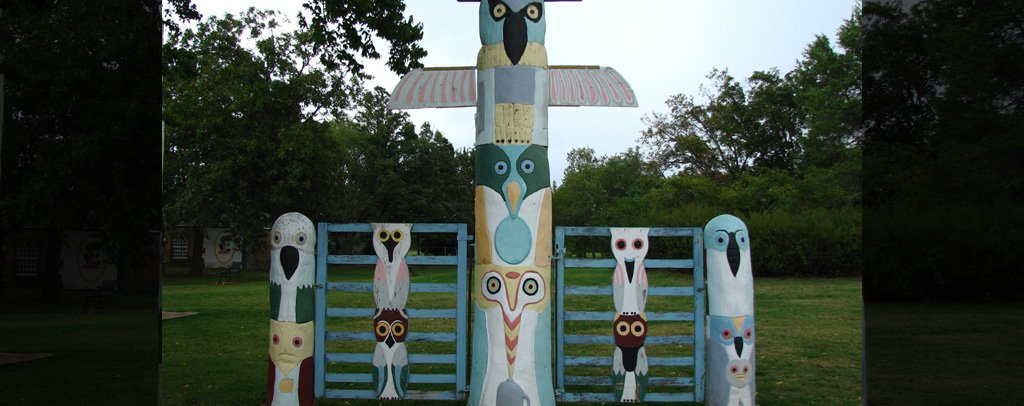
A ninety-foot concrete tower covered with painted birds, faces, figures, and geometric patterns would be flamboyant enough on its own. Ed Galloway’s version stands on an enormous concrete turtle. A few miles off Route 66, the result has the scale of a landmark and the detail of a much smaller handmade artwork.
Galloway began his folk-art environment after retiring in 1937. Smaller decorated structures and the eleven-sided Fiddle House add more of his craftsmanship to the grounds. Outdoor admission is free, though indoor access may follow a different schedule. Take time to look upward as well as around you.
Explore Ed Galloway’s Totem Pole Park in the Oddities Directory.
6. South of the Border
Hamer, South Carolina
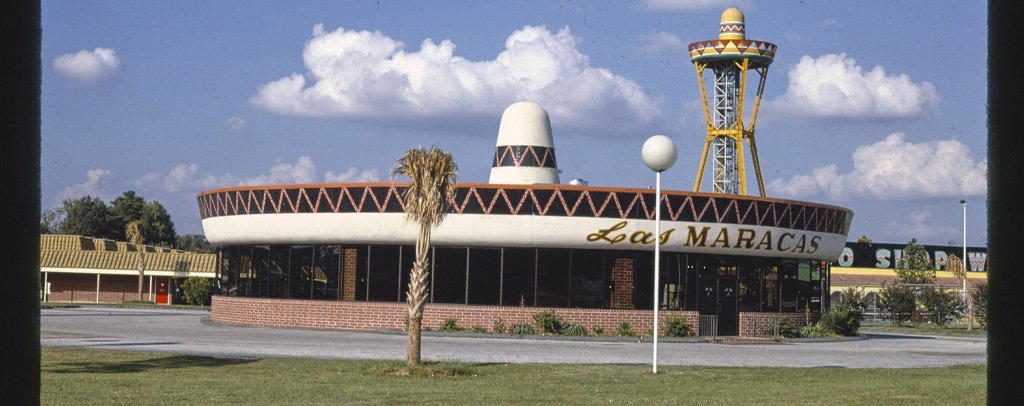
South of the Border commits to color on a highway scale. Neon, oversized figures, brightly colored buildings, and a towering sombrero compete for attention across a sprawling complex beside Interstate 95. The approach signs build anticipation; the architecture makes good on the promise of excess.
The Sombrero Observation Tower rises more than two hundred feet, while shops, food, motel rooms, and attractions fill the property below. Individual features have their own hours and fees, so check details before planning around a particular attraction. This is a stop best enjoyed with an appetite for old-fashioned roadside spectacle.
Explore South of the Border in the Oddities Directory.
7. Wisconsin Concrete Park
Phillips, Wisconsin
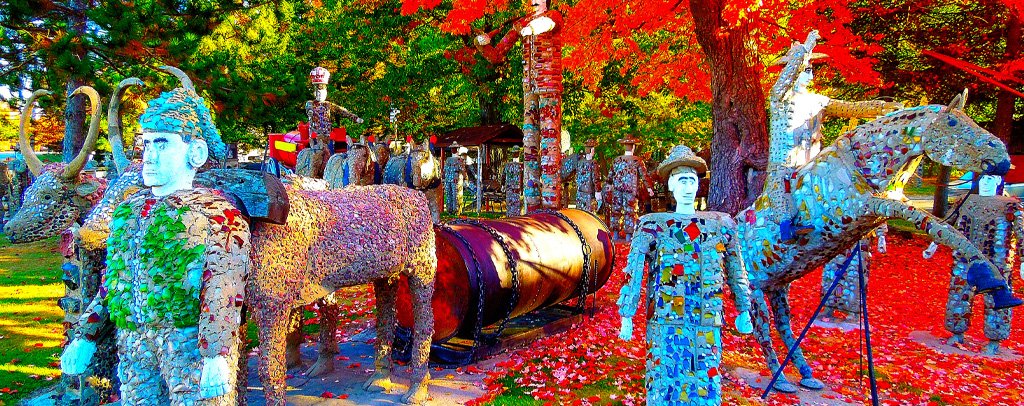
Color at Wisconsin Concrete Park comes from the surfaces as much as the figures. Broken glass, bottles, mirrors, and found objects decorate Fred Smith’s concrete people and animals, catching light and adding glittering detail. The grounds contain 237 sculptures, giving you plenty of reasons to slow down.
Smith began in 1948 after a career as a lumberjack, building his handmade population over sixteen years. Musicians, local characters, historical figures, and animals fill the trails. The park is free, with donations appreciated. Look closely at the embedded materials rather than relying only on a wide photograph.
Explore Wisconsin Concrete Park in the Oddities Directory.
8. Vollis Simpson Whirligig Park
Wilson, North Carolina
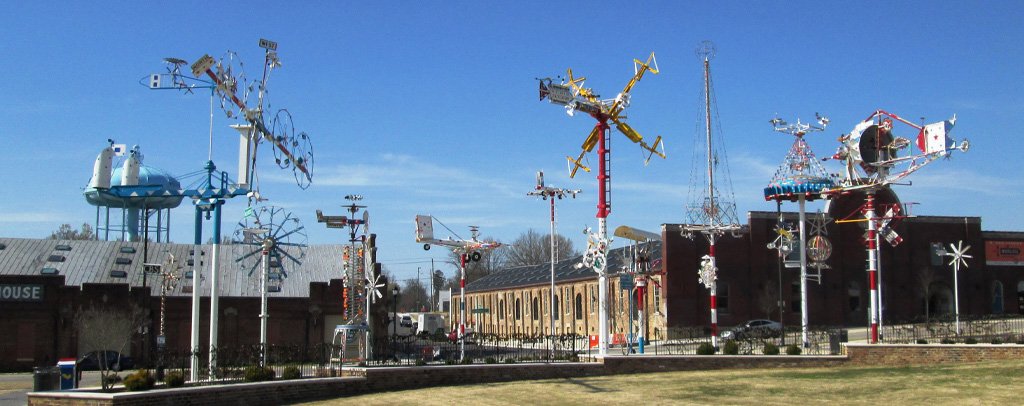
Vollis Simpson’s whirligigs give their bright mechanical details something to do. Wheels, fans, reflectors, gears, and salvaged parts rise into the air, spinning in separate sections as the wind arrives. Thirty restored sculptures make the downtown park feel like a carnival powered by the weather.
Simpson’s repair skills became the foundation for an extraordinary collection of kinetic art. The free, open-air park opened in 2017 after a major conservation effort. Daylight reveals the intricate parts; reflectors and lighting change the effect after dark. Watch for a while, because the next breeze may rearrange the show.
Explore Vollis Simpson Whirligig Park in the Oddities Directory.
Plan a brighter road trip
Pick the stops near your route and check their Directory entries for visitor details. Daylight helps reveal painted surfaces and intricate artwork, while reflective and illuminated displays can offer another look later. Remember that a colorful property may still be someone’s home, and that an outdoor art installation is not automatically an invitation to add your own paint.