
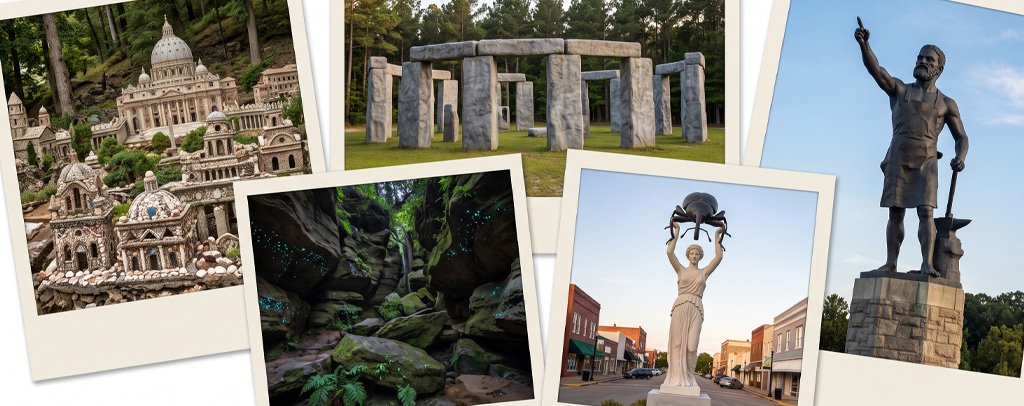
Alabama has a town that thanks a crop-destroying beetle, a monk’s miniature world, and its own version of Stonehenge tucked into the pines. Add a glowing canyon and a giant iron god, and you’ve got five excellent reasons to take the scenic route. These picks from the Oddity Almanac Directory show just how much variety fits into one state’s collection of strange sights.
1. Ave Maria Grotto: Cullman
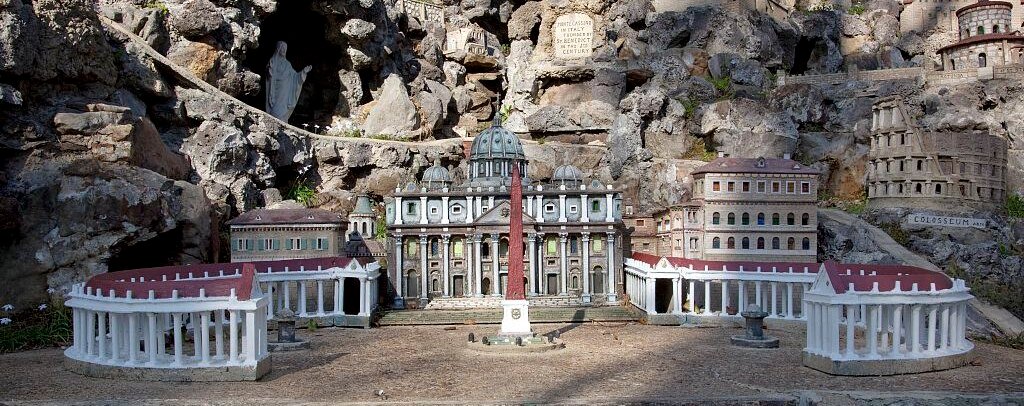
Brother Joseph Zoettl made a miniature world at St. Bernard Abbey without traveling to most of the places he recreated. Working from pictures, books, and his imagination, the Benedictine monk built 125 small structures, including cathedrals, castles, and an imagined Tower of Babel.
The closer you look, the better it gets. Shells, broken tile, marbles, costume jewelry, and even cold-cream jars became architectural details. A walking path winds through the old quarry where the collection stands. It’s a lovely place to linger—and to wonder how many things you’ve thrown away that could have made a perfectly good dome.
2. Bamahenge: Elberta
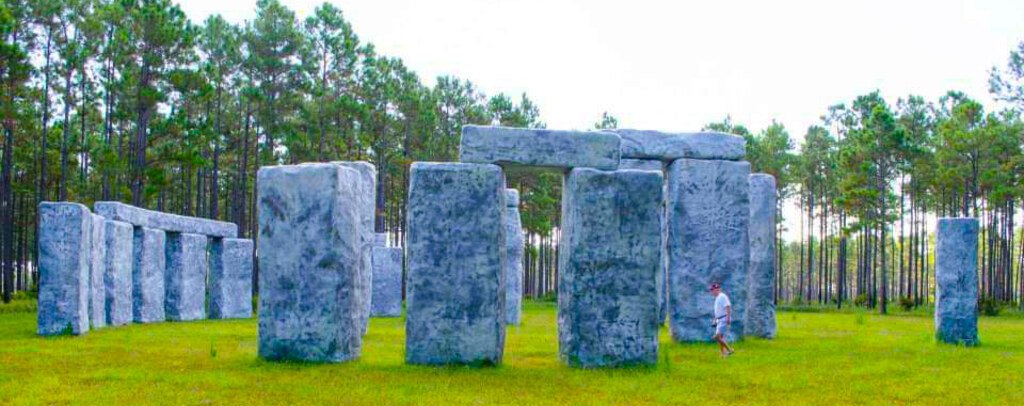
Take a short path into the pine woods near Barber Marina and suddenly you’re looking at Stonehenge. Almost. Bamahenge is a full-scale fiberglass recreation, roughly 21 feet tall and 104 feet across, with a remarkably convincing stone-like finish.
Artist Mark Cline built it for businessman George W. Barber, using four reusable shapes turned in different directions. The replica even follows the summer-solstice sunrise alignment of its English inspiration. Admission is free, and the setting supplies half the fun: you can be heading toward the Alabama coast one minute and standing in a pretend prehistoric Britain the next.
3. Dismals Canyon: Near Phil Campbell
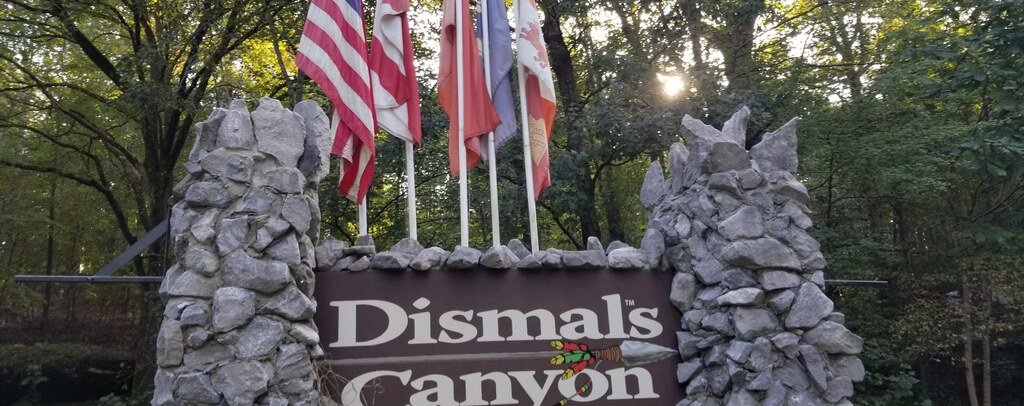
Dismals Canyon saves its strangest sight for after dark. Tiny blue-green lights appear on the sandstone walls, courtesy of bioluminescent fungus-gnat larvae known locally as dismalites. They use their glow to attract insects; visitors get a nighttime spectacle as a bonus.
The canyon is worth a daytime walk too, with mossy rocks, shaded passageways, and two waterfalls. To see the lights, book a guided night tour during a suitable part of the season. Weather and the larvae’s natural cycle affect the display, so leave room for nature to set the brightness. No switch, no guarantee, and no batteries required.
4. Boll Weevil Monument: Enterprise

Enterprise put up a monument to an insect that wrecked its cotton crops. That sounds like a peculiar thank-you until you hear what happened next: the damage pushed local farmers to diversify, with peanuts helping show a way forward.
Dedicated in 1919, the Boll Weevil Monument celebrates that change. The giant beetle held aloft by the female figure came later, making the message considerably harder to miss. Today’s outdoor statue is a replica, installed after damage to the original. View it from the sidewalks around Main and College Streets, then try to think of another town that gave an agricultural pest such an elegant reception.
5. Vulcan Statue: Birmingham

Birmingham chose a 56-foot cast-iron Roman god to advertise its iron-making prowess at the 1904 world’s fair in St. Louis. More than a century later, Vulcan still makes the point rather effectively from his perch on Red Mountain.
The world’s largest cast-iron statue weighs roughly 60 tons. For a time, his raised spearpoint was replaced by a safety torch that glowed red after a traffic death—a sobering job for a colossal city mascot. The spearpoint returned during restoration. Today, Vulcan Park and Museum tells his story, and the observation deck offers a broad view of the city that built him.
Planning a visit? Open each attraction’s directory entry for location and visitor details. Check hours and admission before traveling, and arrange the Dismals Canyon night tour ahead of time if the living lights are on your wish list.