
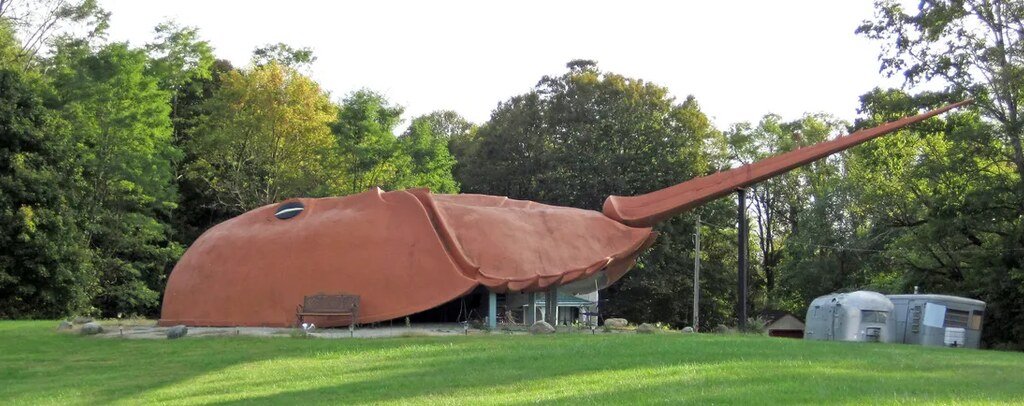
About World’s Largest Horseshoe Crab
A gigantic horseshoe crab now rests beside a rural road near Lenox and Repton, Alabama,hundreds of miles from the nearest natural horseshoe-crab habitat. Nicknamed “Crabbie,” the fiberglass and foam sculpture measures approximately 67 feet long, 28 feet wide, and 12 feet high, not including the long pointed tail rising behind it.
The creature began its unusual migration in the 1990s as part of a maritime exhibition in Baltimore’s Inner Harbor. Its hollow shell was large enough to hold groups of visitors and was reportedly used to present educational material about marine life. When that attraction closed, the enormous arthropod began a series of moves that made its history nearly as odd as its appearance.
Crabbie was acquired by the Creation Museum in Kentucky but proved difficult to incorporate there. It later stood outside a church in Blanchester, Ohio, before being sold and moved to private property near Hillsboro in 2015. The sculpture became a popular roadside photo stop, with visitors able to step beneath or inside portions of its hollow body.
In 2026, the enormous crab moved again, this time to Dinosaur Adventure Land in Conecuh County, Alabama. Transporting a structure of this size requires it to be separated into sections and carefully reassembled. After surviving multiple owners, states, paint jobs, and purposes, the wandering sculpture has become an attraction defined as much by relocation as by scale.
Although the name calls it a crab, a horseshoe crab is more closely related to spiders and scorpions than to true crabs. Enlarging its already prehistoric-looking armored body makes Crabbie resemble a creature from a science-fiction film.
The attraction is located on private organizational property, so visitors should confirm current access before making a special trip. Even viewed from outside, the World’s Largest Horseshoe Crab is one of Alabama’s most unlikely sights: a colossal sea creature that migrated across America by truck.