
About Puʻu Loa Petroglyphs
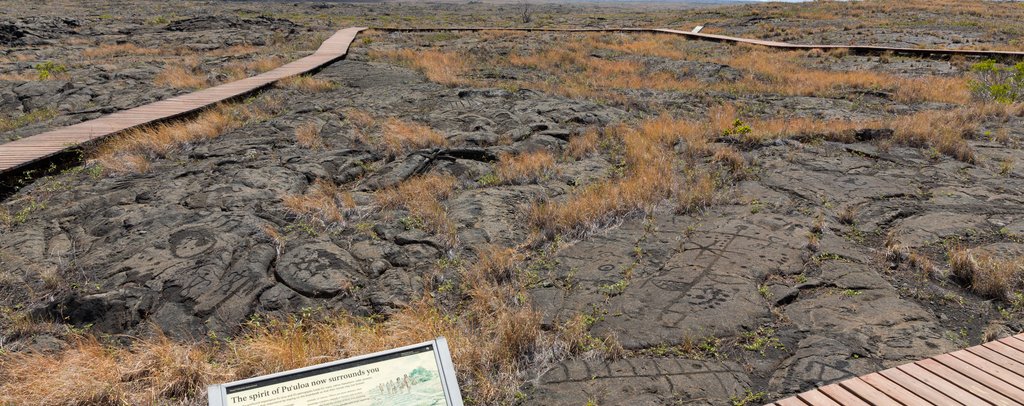
Puʻu Loa is a vast archive carved into lava. More than 23,000 petroglyph images have been recorded across the site in Hawaiʻi Volcanoes National Park, making it the largest known concentration of rock carvings in the Hawaiian Islands. From a distance the dark flow looks nearly empty, but close inspection reveals marks spread across its surface.
The carvings include human figures, circles, geometric designs, canoe-sail shapes, and many forms whose meanings are not fully known. Most are small cup-shaped depressions. These holes are associated with practices involving a child’s piko, or umbilical cord remnant, and prayers for long life, giving the name Puʻu Loa its connection to longevity.
This is not graffiti preserved merely because it is old. The images record generations of Native Hawaiian presence and relationships among family, land, ceremony, and memory. Their meanings cannot be reduced to a single explanation, and the site remains culturally significant rather than functioning only as an outdoor museum.
A 1.4-mile round-trip trail crosses exposed pāhoehoe lava from Chain of Craters Road. The route is generally marked, but the rock can be uneven, sharp, unstable, and extremely hot in direct sun. There is little shade. Water, sturdy footwear, sun protection, and changing-weather preparation are essential.
A boardwalk protects a dense portion of the field and gives visitors a clear view without walking directly on the carvings. Leaving the trail, touching the images, making rubbings, moving rocks, or adding new marks can cause permanent damage. Every visitor shares responsibility for preserving an irreplaceable cultural record.
Puʻu Loa is strange in scale as much as appearance. Tens of thousands of modest marks combine into a landscape-sized human document on stone that was once liquid. The site rewards patient looking, because what first appears to be an empty lava plain gradually resolves into a field crowded with ancestral presence.