
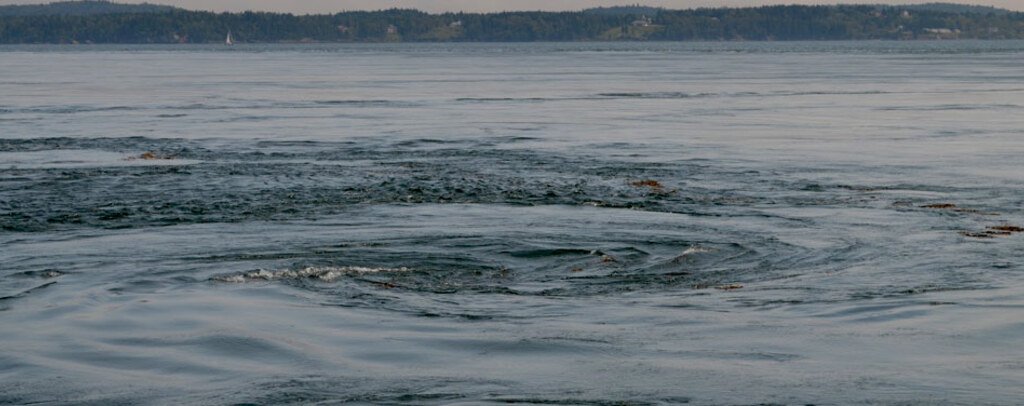
About Old Sow Whirlpool
Between Eastport, Maine, and Deer Island, New Brunswick, the tide can turn the sea into something that looks briefly broken. Currents collide, water begins rotating, and a vast circular disturbance called Old Sow forms in the Western Passage. Smaller whirlpools can appear around it. Naturally, those are called piglets.
Old Sow is created by an unusually complicated combination of strong Fundy tides, underwater terrain, narrow passages, and countercurrents. NOAA describes incoming water making a sharp turn, crossing a deep trench, passing an underwater mountain, and interacting with other currents until part of the flow pinches off into a rotating mass. The whirlpool changes constantly rather than behaving like a permanent drain in the ocean.
Measurements have put Old Sow at more than 250 feet across, and descriptions record a funnel-like drop reaching about 12 feet under extreme conditions. The Maine Atlas Project says it is typically most active around three hours before high tide. Its name may come from the noise of turbulent water resembling pigs at a trough, though another explanation connects “sow” to an older word for a sucking or draining sound.
This is not a novelty to approach casually in a kayak. NOAA and Maine sources warn that the area can be dangerous to small craft when the tide is running. The phenomenon can be observed from safer vantage points and experienced through knowledgeable local boat operators. Old Sow is a rare oddity that needs no sculpture, museum case, or exaggeration. The ocean itself makes a vortex and then surrounds it with piglets.