
About Mushroom Rock State Park
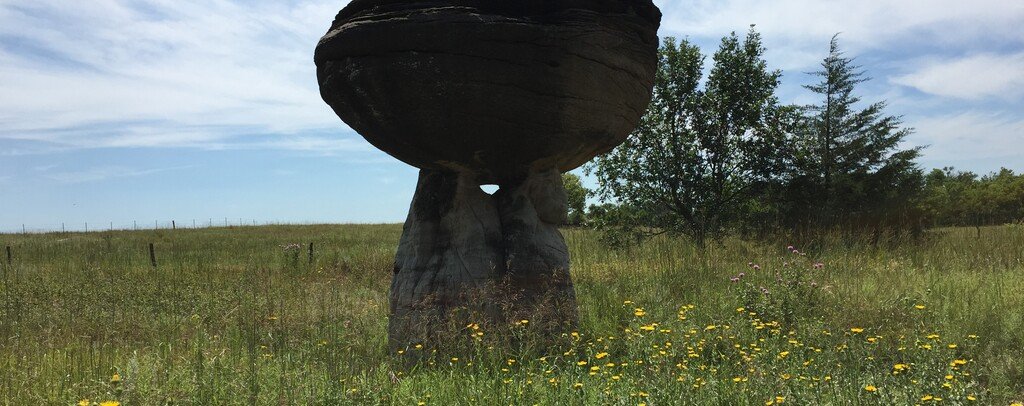
Mushroom Rock State Park contains sandstone formations that look improbably top-heavy. Broad, rounded caps rest on narrower stone stems, producing the silhouettes of giant mushrooms rising from the grass. Other shapes in the compact park have inspired comparisons to a shoe and strange pieces of natural sculpture.
The rocks began as sediment deposited during the Cretaceous Period, when the region lay near an inland sea. Layers cemented with different strengths responded unevenly to weathering. Softer material eroded faster beneath harder caprock, allowing wind, water, freezing, and time to carve balanced forms that appear deliberately constructed.
The largest mushroom cap measures roughly 27 feet across. Its scale becomes clear when visitors walk beneath it and see how little stone appears to support the upper mass. The formations are part of the Dakota Sandstone and offer a concentrated lesson in differential erosion without requiring a long trail or remote backcountry trip.
At about five acres, Mushroom Rock is Kansas’s smallest state park. Its tiny footprint adds to the oddity. A handful of remarkable formations, picnic tables, and short paths occupy a patch of prairie that can be explored quickly, yet the rocks look as though they belong in a much larger desert landscape.
The park is near Marquette at 200 Horsethief Road, reached by local roads west of K-141. It is free to visit and has limited facilities. Wet weather can make the approach muddy, and visitors should avoid damaging or carving the soft stone. Current road information is worth checking before a special trip.
Balanced rocks exist in many places, but these formations are unusually literal. Their stone caps and stems reproduce the basic geometry of mushrooms at monumental scale. Kansas managed to place one of its strangest natural sights inside its smallest state park, making the entire destination feel like a geological display case.