
About Monument Rocks
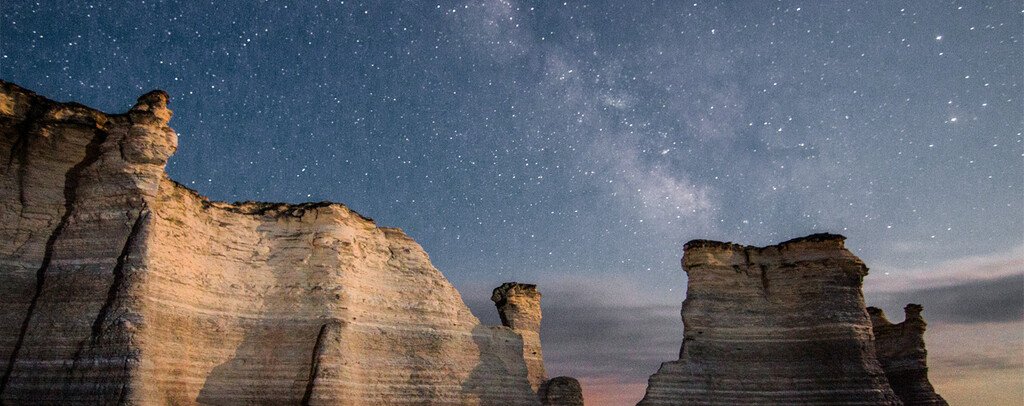
Monument Rocks appears on the western Kansas prairie as a ruined city made from pale chalk. Towers, buttes, narrow walls, and a natural arch rise as much as 70 feet above otherwise open ground. The formations are also called the Chalk Pyramids, a name that suits their sharp silhouettes and unexpected monumentality.
The chalk was deposited roughly 80 million years ago in the Western Interior Seaway, a vast body of water that divided North America. Countless microscopic marine organisms contributed calcium-rich remains to the seafloor. Compacted layers later rose above water and were carved by erosion into the exposed shapes visible today.
Marine fossils appear throughout the chalk, preserving evidence that this dry grassland was once underwater. Fossil fish, reptiles, shells, and other organisms have been found in the surrounding region. The contrast between ocean history and modern prairie makes the rocks feel even more displaced than their architecture-like forms suggest.
Monument Rocks became Kansas’s first National Natural Landmark in 1968. The formations also served as navigational landmarks for Indigenous travelers and later travelers crossing the plains. Weathering continues to alter them, so historic photographs record openings, edges, and towers that have changed or disappeared.
The site is on private property about 20 miles south of Oakley and is generally open from dawn to dusk when conditions permit. Admission is free. Visitors travel on unpaved roads and must follow posted rules, including no climbing, camping, fires, or fossil collecting. Wet roads can make access difficult.
Kansas is often imagined as flat farmland, which makes Monument Rocks an especially effective surprise. Ancient seafloor rises into arches and towers beneath an enormous sky, while marine fossils remain trapped far from any ocean. The landscape looks less like a roadside stop than a misplaced fragment of another planet.