
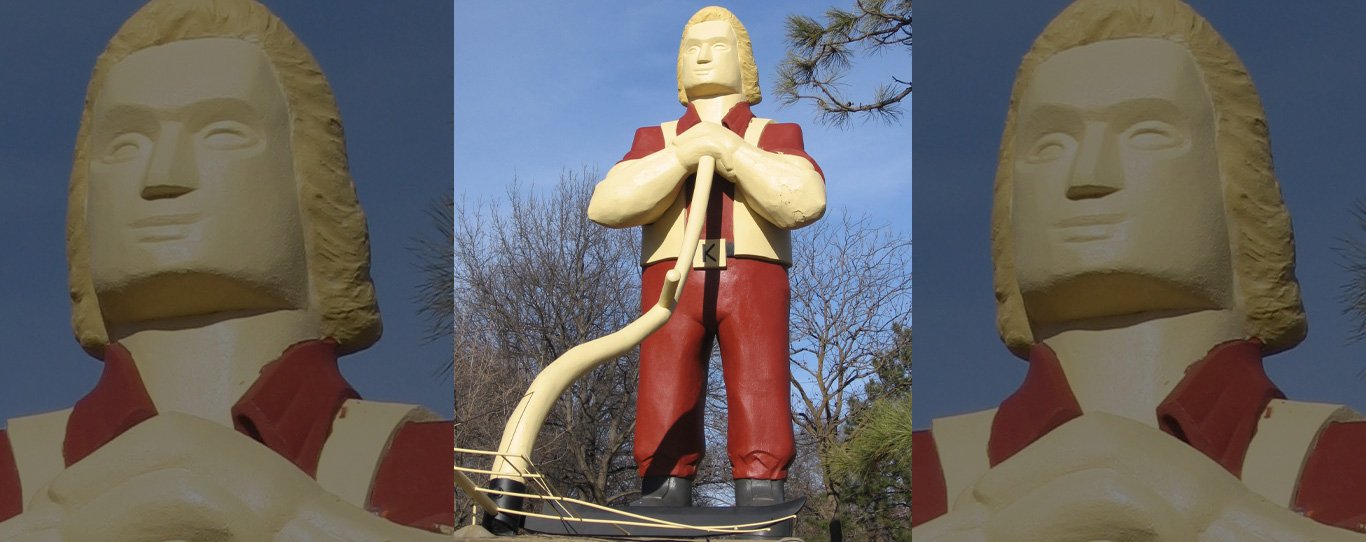
About Johnny Kaw
Johnny Kaw is a larger-than-life fictional pioneer and folk hero commemorated by a collection of concrete sculptures in Manhattan, Kansas. The character was created in 1955 by local horticulture professor George Filinger as a way to celebrate Manhattan’s centennial and create a distinctive attraction for the community. Drawing inspiration from the tall-tale tradition of American folklore, Filinger imagined Johnny Kaw as a Kansas counterpart to legendary figures such as Paul Bunyan.
According to the story, Johnny Kaw was an enormous pioneer whose feats were responsible for shaping the Kansas landscape. The legend explains the state’s geography and agricultural character through a series of deliberately exaggerated adventures. Johnny is said to have helped create the Kansas River, battled enormous prairie creatures, and influenced the region’s farming landscape through his extraordinary strength and determination.
The character’s name is a playful reference to Kansas itself, combining the state’s nickname with the sound of “Kansas.” Like other American tall-tale heroes, Johnny Kaw was never intended to be taken as a historical figure. Instead, he represents the imaginative storytelling tradition that grew alongside settlement and agriculture across the Great Plains.
Filinger’s original project eventually became a physical collection of sculptures in Manhattan’s City Park. The most recognizable figure depicts Johnny Kaw as a giant farmer carrying a massive scythe. Other sculptures commemorate characters and creatures from the legend, including a giant squirrel, a monstrous grasshopper, and Johnny’s enormous cat.
The sculptures were constructed using concrete and steel, giving them the imposing scale expected of a roadside folk hero. Their deliberately exaggerated proportions make the park feel like a three-dimensional version of a tall tale.
Johnny Kaw’s story was also published as a booklet, allowing the legend to spread beyond Manhattan. Although he never achieved the nationwide fame of Paul Bunyan, the character became an enduring piece of local folklore and a symbol of Manhattan’s agricultural heritage.
Today, the Johnny Kaw sculptures remain in City Park and can be viewed by visitors free of charge. The attraction offers something distinctly different from a conventional historical monument: rather than commemorating a real person, it celebrates the creativity of local residents and the tall tales that helped shape the cultural identity of the American Midwest.
For travelers exploring Kansas, Johnny Kaw is a particularly fitting oddity. His oversized figure, strange supporting characters, and fictional explanation of the Kansas landscape capture the humor and imagination of Great Plains folklore in concrete form.