
About John J. Makinen Bottle House
The John J. Makinen Bottle House is a distinctive historic structure in Kaleva, Michigan, a small community in Manistee County founded by Finnish immigrants. Built by Finnish-American immigrant John J. Makinen, the building is remarkable for its extensive use of discarded glass bottles as a construction material.
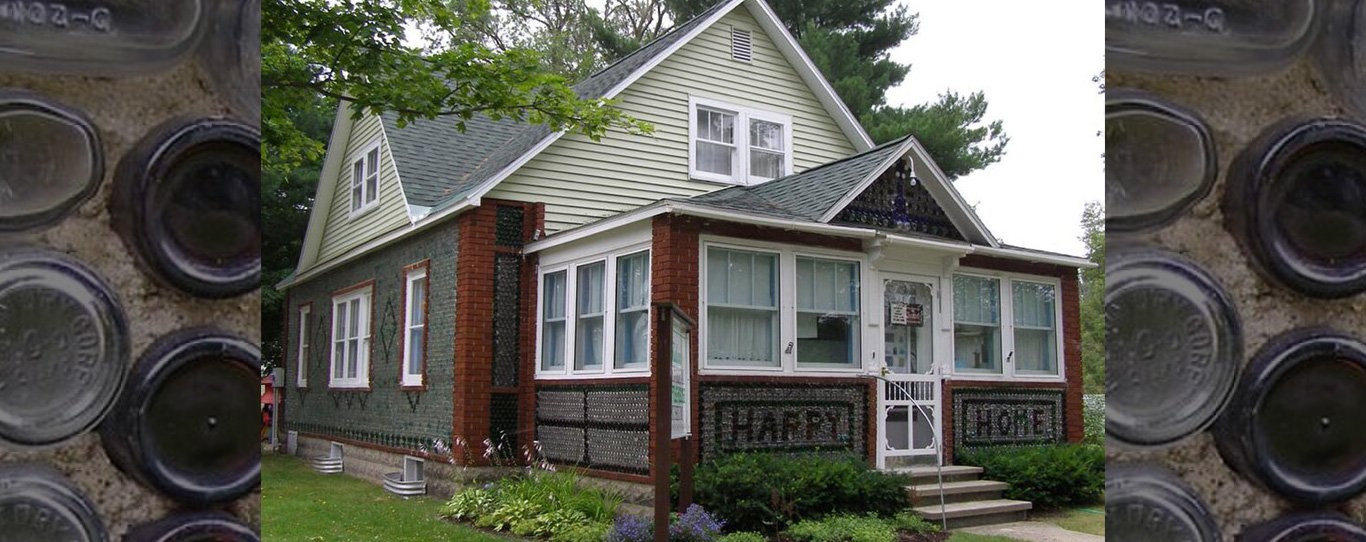
Makinen constructed the Bottle House between 1926 and 1929, during a period when practical reuse of inexpensive or discarded materials was common. Rather than allowing thousands of empty bottles to go to waste, Makinen incorporated them into the building’s walls. The bottles are arranged within the masonry so that their bottoms are visible from the exterior, producing a striking pattern across the walls.
More than 65,000 bottles were used in the construction. The sheer quantity makes the building unusual enough on its own, but the bottles also give the structure a distinctive appearance. Different shades of glass create subtle variations in color, particularly when sunlight passes through portions of the walls.
The Bottle House was not simply constructed as a novelty. Makinen was an experienced builder who used the bottles as part of a functional structure. The building originally served as a residence and later had other community uses. Its construction reflects the practical creativity associated with many immigrant communities that settled in Michigan’s northern forests and developed ways to make use of whatever materials were available.
Kaleva itself provides important context for the building. The village was established by Finnish immigrants and retains a strong Finnish cultural identity. Makinen’s Bottle House is therefore more than an unusual architectural curiosity; it is also a surviving artifact of the community’s early history and the resourcefulness of its Finnish-American residents.
The building eventually attracted attention beyond Kaleva because of its unusual construction. Its historic importance was recognized when the John J. Makinen Bottle House was added to the National Register of Historic Places in 1980.
Today, the Bottle House stands as one of Michigan’s most distinctive examples of vernacular architecture. It is not a grand mansion or architect-designed monument. Instead, its appeal comes from the inventive use of an everyday discarded object on an extraordinary scale.
For travelers exploring Michigan’s smaller communities, the structure offers a glimpse into a different side of American architectural history, one in which ingenuity and reuse could turn thousands of empty bottles into a permanent landmark.