
About Hagerman Fossil Beds
The bluffs above the Snake River near Hagerman contain one of the richest known fossil deposits from the Pliocene epoch. The monument protects fossils roughly three to four million years old, preserving evidence of an Idaho populated by animals that included camels, mastodons, saber-toothed cats, and ancient horses.
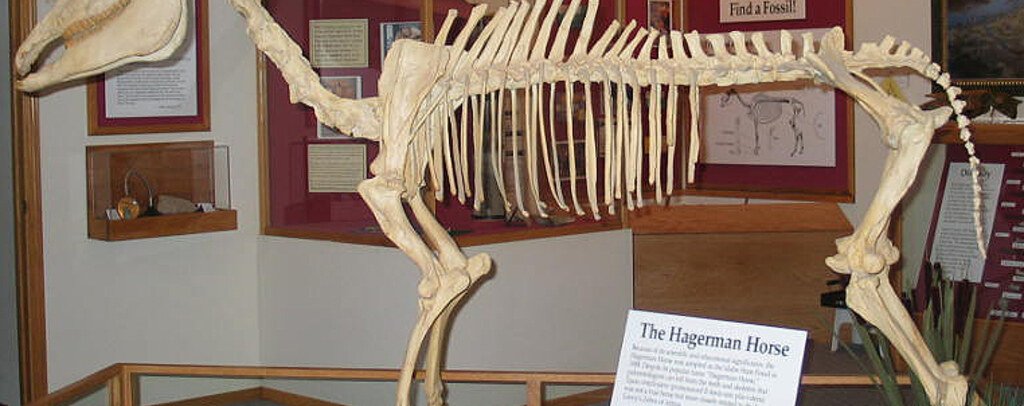
The best-known discovery is the Hagerman horse, Equus simplicidens. It was not a modern horse buried in an unusual place, but an extinct relative with features associated with both earlier and later members of the horse family. The site produced the largest known concentration of its remains.
Fossils from at least two hundred species have been identified in the area. Fish, frogs, turtles, birds, rodents, carnivores, and large mammals reveal an ecosystem very different from the dry landscape visible today. The variety makes the beds important for understanding climate, evolution, and environmental change.
The fossils are not exposed for casual collecting, and the original Hagerman Horse Quarry is closed to the public. Instead, visitors see specimens and reconstructions at the Thousand Springs Visitor Center, which is jointly operated for the national monument and the surrounding state park.
The visitor center stands about one mile north of downtown Hagerman on U.S. Highway 30. It offers fossil exhibits, maps, ranger information, restrooms, and drinking water. Scenic overlooks and trails lie several miles away, and the National Park Service warns that general map searches may direct travelers to the wrong location.
Hagerman’s oddness lies beneath an otherwise quiet stretch of Idaho. The eroded bluffs function as a deep archive filled with animals that seem misplaced in the modern Northwest. A reconstructed horse skeleton gives the ancient landscape a recognizable centerpiece, but the wider fossil community is even stranger.