
About Garden of Eden
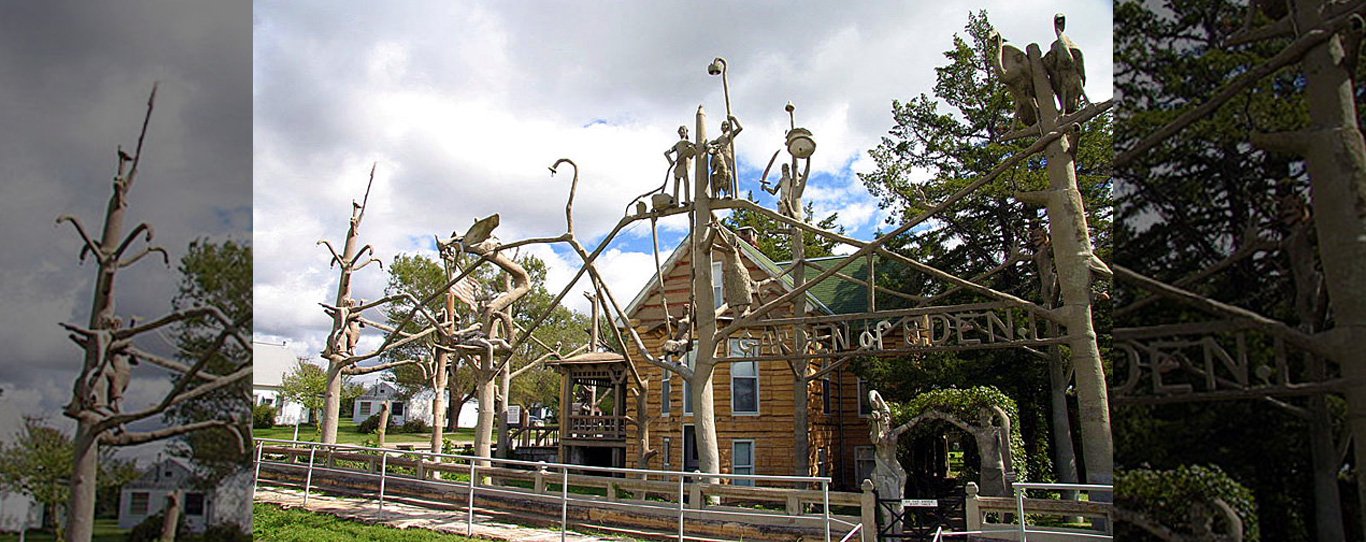
The Garden of Eden is an extraordinary folk-art environment in Lucas, Kansas, created by Civil War veteran, farmer, teacher, and sculptor Samuel P. Dinsmoor. After retiring from farming in 1905 at age 62, Dinsmoor embarked on a second career that would consume the rest of his life: transforming his home and property into a sprawling landscape of concrete sculpture.
Dinsmoor began constructing the Garden of Eden in 1907, building a twelve-room house from limestone quarried in the region. He fashioned the walls to resemble logs, giving the building its distinctive appearance and earning it the name “Cabin Home.” Around the house, he gradually filled the property with an enormous collection of concrete sculptures.
The sculptures reflect Dinsmoor’s personal beliefs, particularly his religious convictions and his support for the Populist political movement. Biblical figures and scenes appear alongside representations of political and social ideas. One of the most striking works is a sculpture depicting “Labor Crucified,” surrounded by figures representing the forces Dinsmoor believed exploited working people. The result is less a traditional garden than a three-dimensional expression of one man’s worldview.
Dinsmoor continued working on the property for the rest of his life, eventually creating more than 200 concrete sculptures. The Garden of Eden became a highly personal environment in which architecture, sculpture, politics, religion, and autobiography were all intertwined.
Perhaps the strangest part of the Garden of Eden is its mausoleum. Dinsmoor constructed his own above-ground tomb on the property and made arrangements for his body to remain on display after his death. When he died in 1932, he was placed inside a concrete coffin topped with a glass lid. Visitors on guided tours can still see his preserved remains. The mausoleum also contains a remarkable double-exposure photograph depicting Dinsmoor viewing his own body in the coffin.
The Garden of Eden is now recognized as an important example of American outsider and folk art. It was added to the National Register of Historic Places in 1977, helping ensure the preservation of Dinsmoor’s unusual creation.
Today, visitors can explore the exterior sculptures and take seasonal guided tours of the Cabin Home and mausoleum. The Garden of Eden remains one of Kansas’s most distinctive destinations—a place where a retired farmer turned his home into a permanent monument to his beliefs, imagination, and remarkably unconventional artistic vision.