
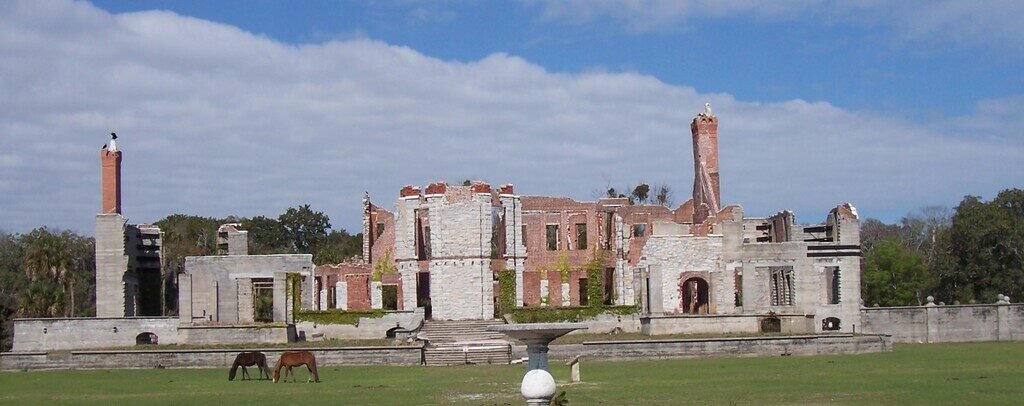
About Dungeness Ruins
Roofless stone walls, tall chimneys, and empty windows mark the remains of Dungeness near the southern end of Cumberland Island. The mansion’s formal footprint still suggests Gilded Age grandeur, but maritime forest, salt air, and open sky now surround the shell. Wild horses often graze nearby, giving the ruins an atmosphere that feels carefully staged even though it is real.
The estate’s name predates the Carnegie mansion. Revolutionary War general Nathanael Greene acquired land on Cumberland Island in the eighteenth century. After his death, his widow Catharine and her second husband, Phineas Miller, built an earlier tabby house on the property. That first Dungeness hosted prominent visitors and helped establish the site as an important coastal estate.
Thomas and Lucy Carnegie purchased much of Cumberland Island in the 1880s. Construction began on a large Queen Anne and Shingle Style mansion with dozens of rooms, extensive grounds, pools, outbuildings, and housing for workers. Thomas died before completion, but Lucy and their children continued using the estate and built additional houses elsewhere on the island.
The family left Dungeness vacant after the 1920s. Fire destroyed the mansion in 1959, leaving masonry walls and chimneys standing. The National Park Service acquired the property in the 1970s and now preserves the ruin as part of Cumberland Island National Seashore rather than reconstructing the vanished house.
Reaching the ruins requires planning because Cumberland Island has no bridge. Most visitors take a reserved ferry from St. Marys and walk or bicycle from the dock. Food, water, weather, insects, and ferry departure times all matter. The ruins are visible from designated paths, and barriers protect unstable areas.
Dungeness joins two kinds of spectacle that rarely share the same frame. The remains of extreme private wealth stand inside a protected wilderness where animals roam without regard for lawns, family fortunes, or architectural symmetry. That contrast makes the ruin more memorable than a restored mansion could be.