
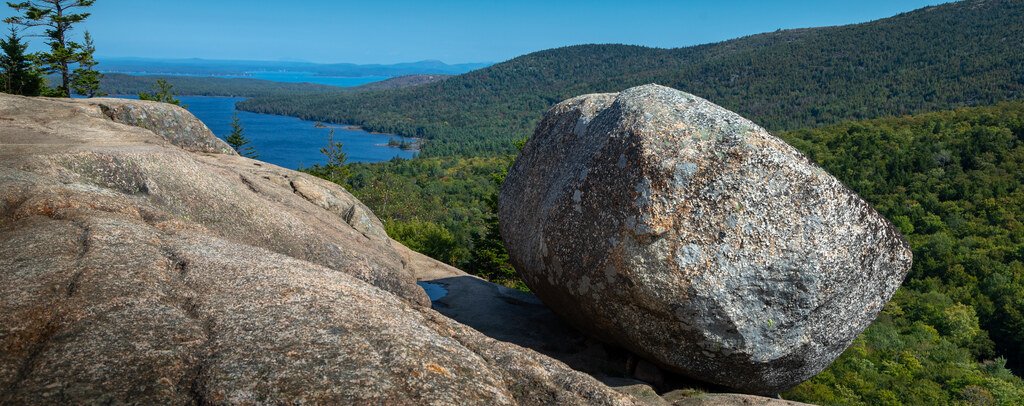
About Bubble Rock
Bubble Rock looks like a geological prank. A rounded chunk of granite sits near the edge of South Bubble in Acadia National Park, appearing so badly placed that the obvious question is why gravity has not finished the job.
The answer begins with a glacier. Bubble Rock is a glacial erratic, meaning it was transported by moving ice and deposited on bedrock different from the stone itself. National Park Service interpretation identifies the boulder as Lucerne Granite, while South Bubble is made of Cadillac Mountain Granite. Similar Lucerne rock occurs roughly 30 to 40 miles northwest of the park, revealing just how far the boulder traveled before the melting ice left it behind.
Its exact quoted weight varies among National Park Service materials, but there is no question that it is enormous. One current NPS wayside description gives a weight of about 28,000 pounds. The stranger part is not merely the size. It is the placement. From certain angles, the rock appears to be resting at the very lip of the mountain, with open space and forest dropping away behind it.
Bubble Rock is reached by hiking in Acadia rather than by walking up from a roadside parking space. The Bubbles hike includes uneven terrain, stairs, exposed granite, and steep sections, and wet rock can be slick. Visitors should follow current NPS trail guidance and leave the boulder exactly where the glacier put it. Nature already spent thousands of years setting up the joke.