
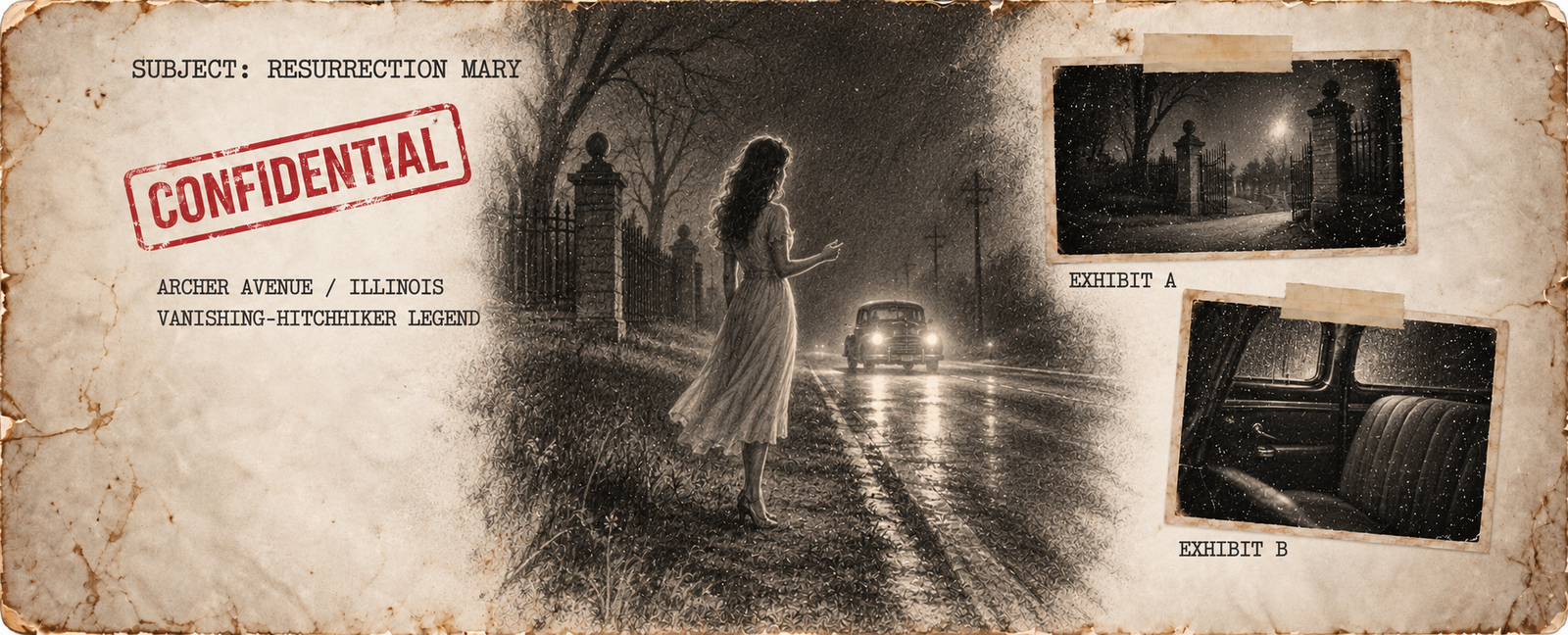
Resurrection Mary belongs to the broader vanishing-hitchhiker story family but has unusually strong ties to specific Chicago-area places. Since the twentieth century, stories have described a young woman in a white or pale formal dress appearing along Archer Avenue, sometimes accepting a ride or appearing at a dance hall. The encounter ends when she vanishes near Resurrection Cemetery in Justice, Illinois.
The legend is often linked with the former Oh Henry Ballroom, later the Willowbrook Ballroom, in Willow Springs. The standard biography says Mary died in a road accident after leaving a dance and was buried in her party clothes. Researchers have tried to match that story with real young women buried at Resurrection Cemetery, but the Chicago History Museum notes that no proposed identity has been established conclusively. Individual encounter stories also vary in date, location, and details.
Mary’s durability comes from the combination of a familiar migratory legend and a real landscape of cemetery gates, old ballrooms, taverns, and a heavily traveled historic road. Stories of damaged cemetery bars being marked by ghostly handprints became another famous layer, although cemetery officials attributed the damage to a vehicle. Mary remains a figure of Chicago folklore whose identity has not been conclusively established.
Evidence and interpretation
Resurrection Cemetery, Archer Avenue, the ballroom tradition, decades of reported encounters, and the Resurrection Mary legend are documented. No historical candidate has been conclusively identified as Mary, and no apparition has been independently verified.