
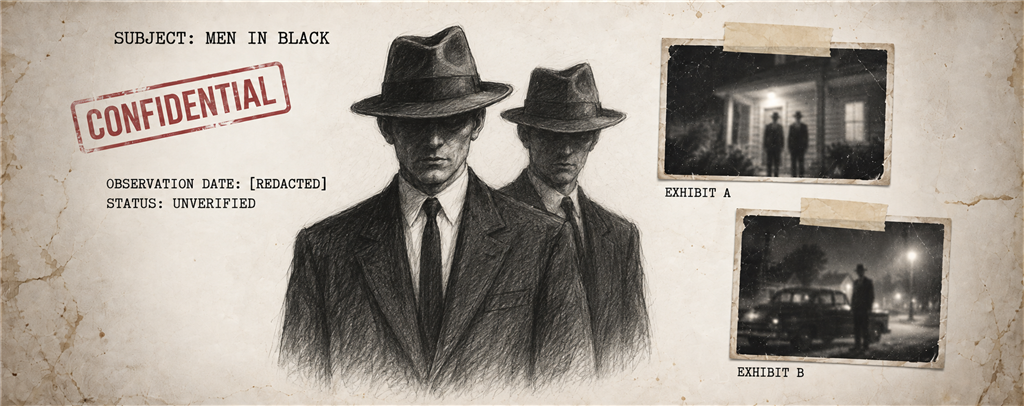
The Men in Black are mysterious visitors said to appear after UFO sightings or investigations, usually questioning, intimidating, or warning witnesses to remain silent. The modern legend took shape during the 1950s around UFO investigator Albert K. Bender. Bender founded the International Flying Saucer Bureau in 1952 but abruptly closed the organization the following year, saying that he had been ordered to stop pursuing the subject. He later described a disturbing encounter with three darkly dressed men whom he connected to the UFO mystery.
West Virginia writer Gray Barker transformed Bender’s experience into durable folklore. Barker’s 1956 book They Knew Too Much About Flying Saucers publicized the idea of sinister visitors suppressing UFO information. The West Virginia Encyclopedia and WVU Libraries both identify Barker as a central figure in establishing the Men in Black within UFO culture. Later writers expanded the pattern, describing visitors who seemed alternately like government officials, extraterrestrials, impostors, or something less easily categorized.
Barker’s reliability complicates the story. Archival research and accounts from people who knew him indicate that he sometimes treated UFO material as entertainment and participated in hoaxes. That history does not erase the Men in Black as folklore. Instead, it helps explain how stories, deliberate inventions, genuine fears about secrecy, and ambiguous encounters with officials could reinforce one another. By the later twentieth century, the dark suit, expressionless manner, strange questioning, and implied threat had become instantly recognizable pieces of UFO mythology, eventually separating almost completely from Bender’s original story.
Evidence and claims
Bender’s organization, its closure, Barker’s books, and the growth of the Men in Black legend are documented. No secret organization of nonhuman or government "Men in Black" has been independently established from these stories.
Sources
- wvencyclopedia.org — Supports Barker biography and his role in Men in Black folklore.
- news.lib.wvu.edu — Supports Barker’s publishing history and introduction of the concept into UFO folklore.
- encyclopedia.com — Supports the Bender foundation story and later development.
- skepticalinquirer.org — Supports recent archival perspective on Barker’s reliability and influence.