
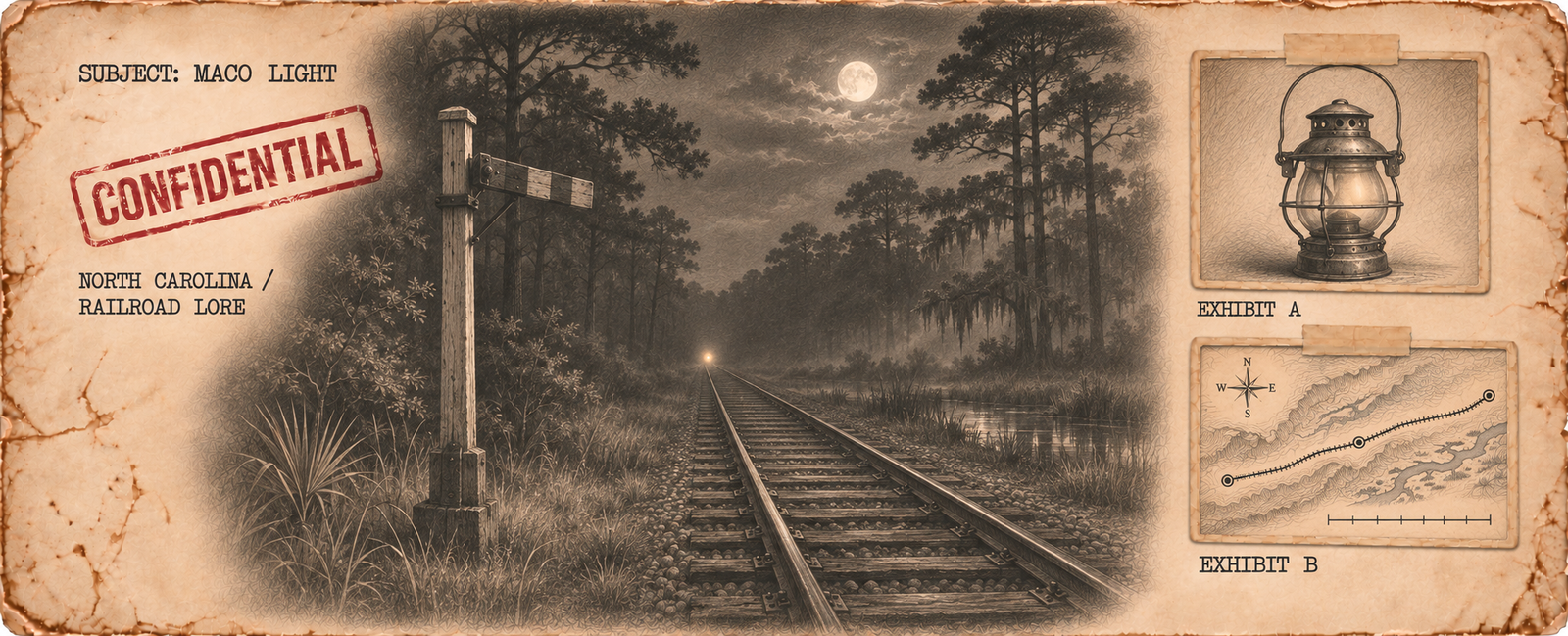
For generations, people at Maco west of Wilmington reported a mysterious light moving along the railroad tracks and disappearing when approached. The familiar legend calls the ghost "Joe Baldwin," a conductor supposedly decapitated while trying to warn an approaching train with a lantern. His wandering light then searches the tracks for his missing head.
North Carolina archival research reveals a different historical accident. On January 4, 1856, a locomotive near Hood's Creek returned toward cars it had temporarily uncoupled and collided with them in the darkness. Conductor Charles Baldwin was thrown from an open door, suffered severe head injuries, and died three days later. Investigators also found that Baldwin had been responsible for placing a warning light that was missing. He was not the decapitated "Joe" of the later legend.
The light itself became a well-known railroad tradition, and later versions absorbed the more dramatic severed-head narrative. Proposed explanations included distant artificial lights and environmental effects. The most striking historical change came when the tracks were removed in 1977: the North Carolina Department of Natural and Cultural Resources reports that the light has not been seen since. That pattern makes Maco an excellent example of how a real accident, a recurring visual phenomenon, and repeated storytelling can gradually create a much more elaborate ghost narrative.
Evidence and Interpretation
Charles Baldwin's 1856 accident and death are documented. "Joe" Baldwin's decapitation and search for his head are later folklore. The reported Maco Light tradition was real, but no supernatural origin was established.
Sources
- North Carolina Department of Natural and Cultural Resources reconstruction of the 1856 Charles Baldwin accident and the later Joe Baldwin legend.
- North Carolina State Archives educational material comparing the legend with newspapers, coroner material, and other original records.
- Encyclopedia of North Carolina account documenting the long Maco Light tradition and later versions of the railroad legend.
- Wilmington Railroad Museum page preserving the later popular form of the Joe Baldwin story for comparison with archival history.