
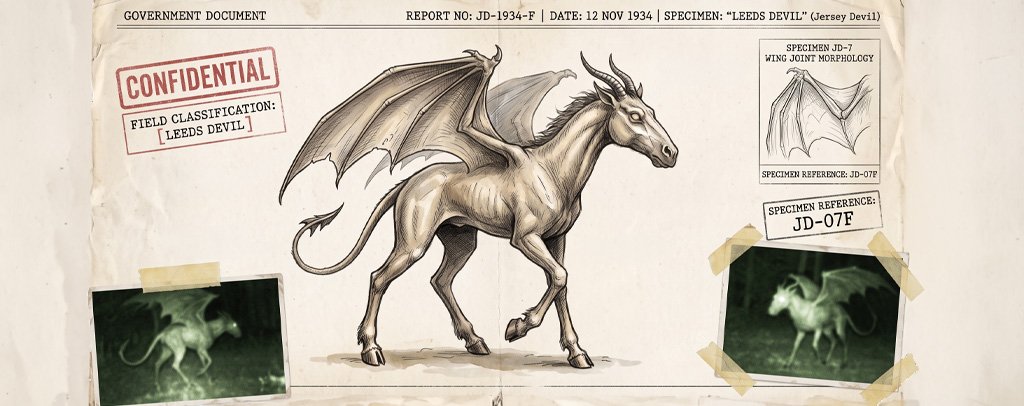
Few American monsters have accumulated as many spare parts as the Jersey Devil. Depending on the witness or the artist, it may have a horse-like head, horns, a forked tail, cloven hooves, short front legs, leathery wings and a body that seems assembled from several unrelated animals.
Its home is the Pine Barrens, the vast stretch of forest and wetlands covering much of southern New Jersey.
The best-known origin story begins with a woman remembered as Mother Leeds. Pregnant with her thirteenth child and already overwhelmed, she supposedly cursed the unborn baby—or declared that it might as well be the Devil. The child was born, transformed into a monstrous creature and escaped through the chimney before disappearing into the Pines. Other versions change the curse, the mother, the circumstances of the birth and even the creature itself. The older regional name was the Leeds Devil.
The Jersey Devil became something more than a local fireside tale in January 1909. For about a week, newspapers reported strange tracks and sightings across New Jersey and into neighboring Pennsylvania and Delaware. Residents described winged creatures on rooftops, unexplained hoofprints in the snow and terrible cries in the night. The New Jersey Historical Society describes hundreds, possibly thousands, of claimed sightings during the brief frenzy.
The descriptions were anything but consistent. That is part of the Jersey Devil’s charm and part of the difficulty in treating it as a conventional unknown animal. Owls, cranes, other wildlife, pranksters and the contagious excitement produced by sensational newspaper coverage have all been suggested as explanations for particular reports.
No physical evidence has established the existence of a strange animal roaming the Pine Barrens. What does exist is more durable: a regional monster that has been passed from generation to generation for centuries.
Today the Jersey Devil is inseparable from New Jersey identity. It appears in books, television, local businesses and the name of the state’s NHL team. The Pine Barrens may contain no winged beast, but they have proven to be excellent habitat for a legend.