
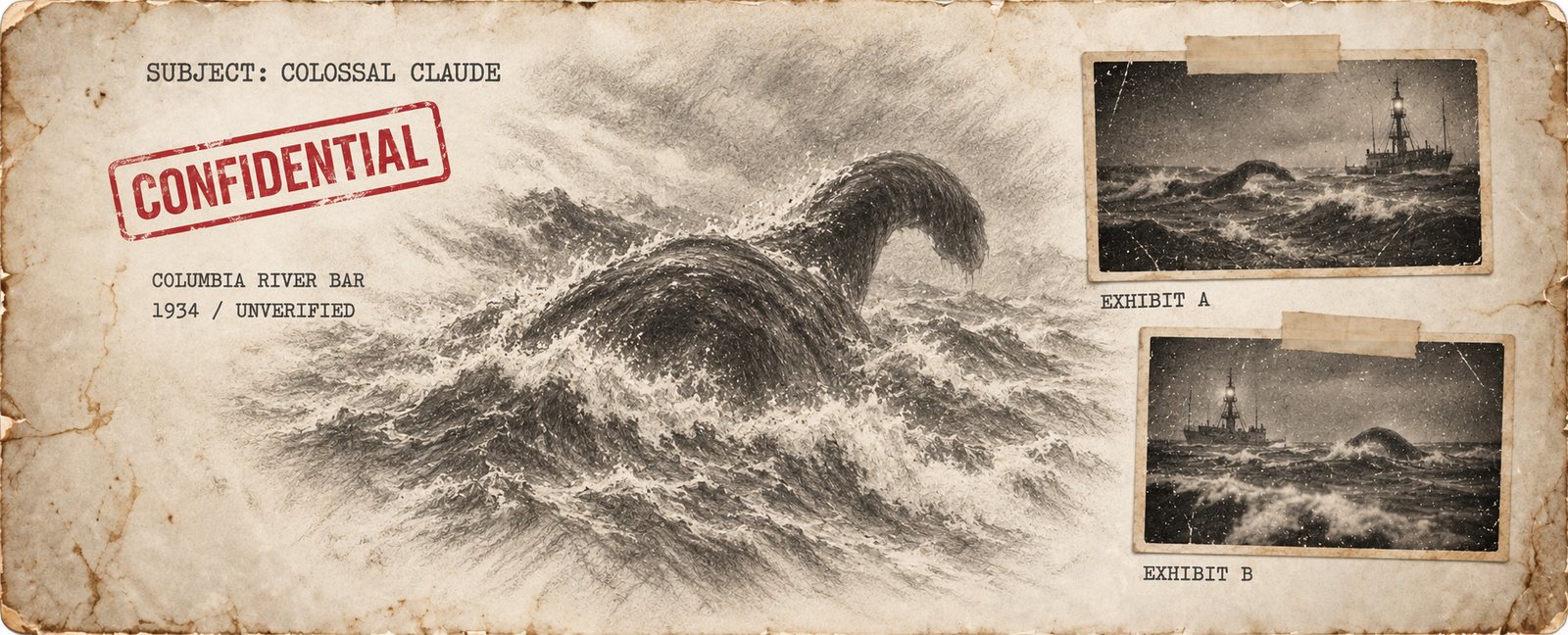
Colossal Claude entered Oregon maritime folklore in March 1934 near the mouth of the Columbia River. Contemporary reporting described crews associated with the Columbia River lightship and its tender watching a large unidentified animal through field glasses. First mate L. A. Larson described something roughly forty feet long with a long neck, large body, tail, and unusual head. Other witnesses disagreed on details, including whether the head looked more snake-like or camel-like.
Similar stories appeared during the next several years. In 1937, the crew of the fishing vessel Viv reported a long, tan or hairy creature with a horse-like head. Other coastal witnesses described large necked animals farther south. In April 1939, the crew of the fishing boat Argo reported an especially close encounter near the Columbia River, claiming that a large animal approached their fishing gear before disappearing.
No carcass, photograph, tissue sample, or preserved physical evidence ties these reports to an unknown species. Whales, sea lions, large fish, unusual waves, debris, exaggeration, and sailor storytelling remain plausible ingredients. The Columbia Bar itself is famously hazardous, with powerful currents and difficult visual conditions. Claude’s significance comes from a compact cluster of 1930s newspaper-era maritime reports involving working crews rather than from proof of a surviving prehistoric reptile.
Evidence and claims
The 1934 lightship-associated report and later 1930s newspaper stories are documented. No verified physical evidence identifies the reported animals or establishes that all sightings involved the same creature.
Sources
- oregoncoastmagazine.com — Oregon Coast Magazine history of Columbia Bar lightships, LV-88, and the 1934 crew encounter that became associated with Colossal Claude.
- offbeatoregon.com — Oregon history reconstruction based on Morning Oregonian archives and later maritime reports from the 1930s.
- crmm.org — Columbia River Maritime Museum history confirming that LV-88 later entered the museum’s collection before being replaced by WLV-604.
- archives.gov — National Archives inventory confirming the later Coast Guard service record of LV-88, useful for vessel identification and chronology.