
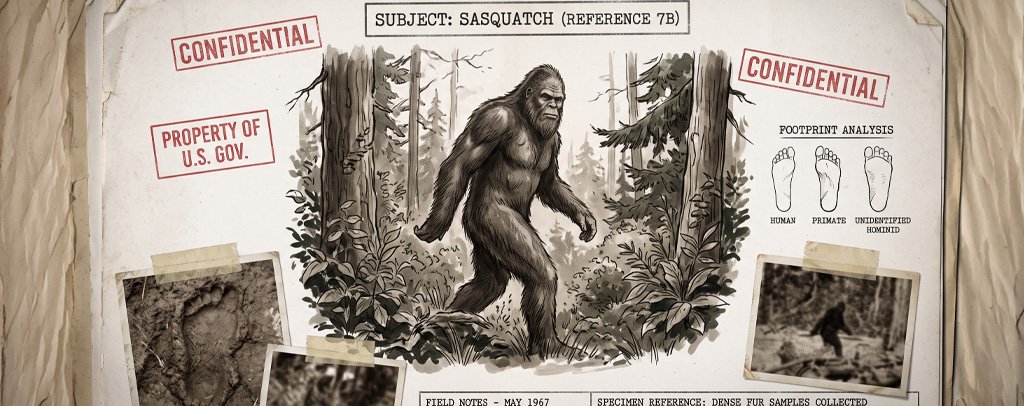
The modern Bigfoot legend took recognizable form in northern California in 1958 after large humanlike footprints appeared around a road-construction site near Bluff Creek. Bulldozer operator Jerry Crew made a plaster cast and brought it to the Humboldt Times, whose coverage helped send the name "Bigfoot" into national circulation. Reports of large hairy wild people existed long before 1958, but the newspaper coverage transformed a regional cluster of stories into a modern cryptid with a recognizable name and increasingly standardized appearance.
The most famous visual evidence arrived on October 20, 1967, when Roger Patterson and Bob Gimlin filmed a hair-covered, upright figure walking beside Bluff Creek. The short film remains disputed. Supporters argue that body proportions and movement are difficult to reproduce, while skeptics interpret the figure as a person in a costume. Numerous footprints, photographs, recordings, and hair samples have been offered since then, but none has produced a scientifically accepted specimen of an unknown North American primate.
Genetic testing illustrates the evidence problem. A 2014 peer-reviewed study examined hair samples attributed to Bigfoot, Yeti, and other anomalous primates and found DNA from known mammals rather than a new North American ape. The name "Sasquatch" also requires cultural care. Sts’ailes sources explain that the English word derives from their Halq’emeylem term Sa:sq’ets and that Sa:sq’ets carries specific cultural meaning as a caretaker of the land. Sts’ailes teachings and other Indigenous traditions are distinct from the modern zoological Bigfoot profile.
Evidence and claims
The 1958 footprint publicity, Patterson-Gimlin film, later reports, and scientific examination of claimed samples are documented. No body, DNA sequence, or other physical specimen has established a previously unknown North American great ape. Sts’ailes Sa:sq’ets tradition should be described only from Sts’ailes sources and not treated as proof of the modern cryptid.
Sources
- humboldthistory.org — Humboldt County Historical Society overview of the late-1950s footprint reports and emergence of the name Bigfoot.
- smithsonianmag.com — Smithsonian history of modern Bigfoot culture, including Bluff Creek, the Patterson-Gimlin film, hoax concerns, and the continuing evidence debate.
- pmc.ncbi.nlm.nih.gov — Peer-reviewed 2014 genetic analysis of hair samples attributed to Bigfoot and other anomalous primates.
- stsailes.com — Sts’ailes community source explaining the cultural meaning of Sa:sq’ets and the origin of the anglicized word Sasquatch.
- commons.wikimedia.org — Public-domain file page for a frame from the 1967 Patterson-Gimlin film, reviewed as a possible image but not selected because of size and interpretive concerns.