
About Paper House
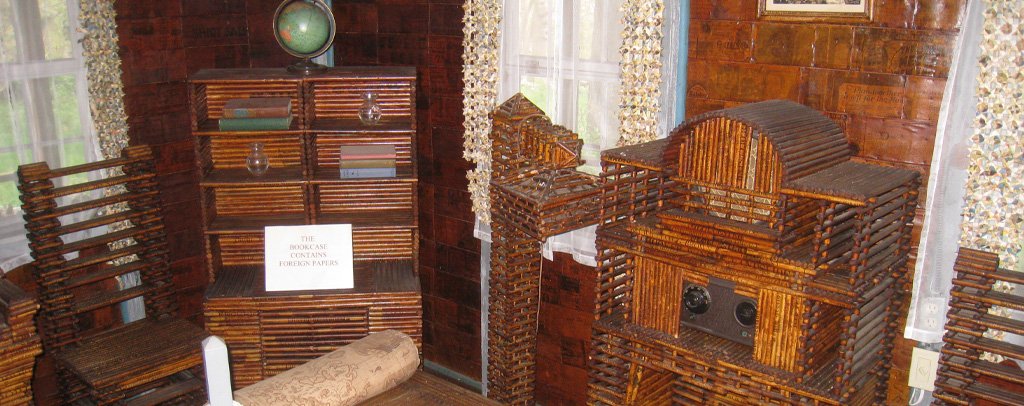
A normal wooden frame stands underneath the Paper House in Rockport, but that is where normal ends. The walls are built from layers of newspaper pressed together with homemade glue, then protected with varnish. Even more newspaper was rolled, folded, and shaped into furniture until the summer home became an experiment in how far one cheap everyday material could be pushed.
Mechanical engineer Elis F. Stenman began the project in 1922. Newspaper was initially intended as insulation, but Stenman kept experimenting. The walls eventually became about an inch thick, and he created paper desks, chairs, tables, and other pieces for the interior. A real piano was covered in paper, while a grandfather clock incorporates newspapers from each of the 48 states that existed when it was made.
The result is not a paper shell pretending to be a house. Stenman and his wife actually used the building as a summer home. It had electricity and running water, and its brick fireplace could be used. Decades later, portions of the old newsprint can still be read where the protective surface has worn thin, turning the walls into an accidental archive.
The Paper House operates as a small seasonal attraction and sits on a narrow residential road. Its official site warns that signs can be easy to miss and that large tour buses cannot make the turn up Curtis Street. Visitors should check current hours before traveling. Few buildings make the phrase “paper-thin walls” feel quite this literal.