
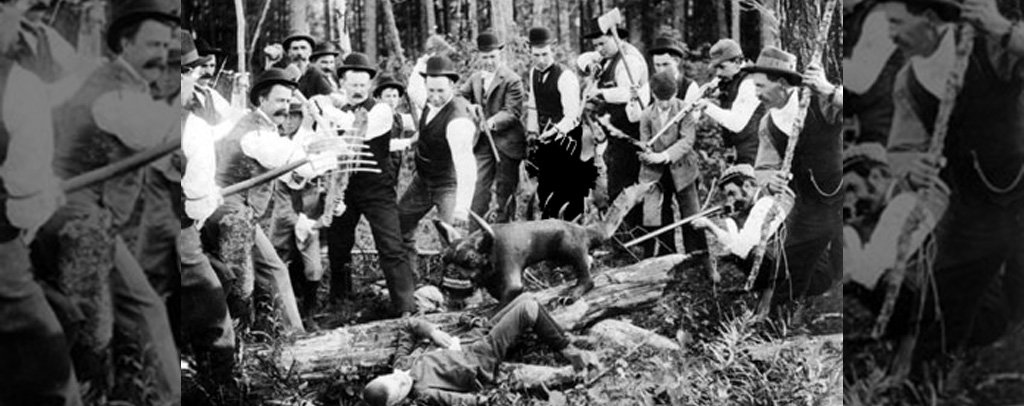
The Hodag is a horned, fanged, spiny-backed monster associated with the logging country around Rhinelander, Wisconsin. Modern depictions usually give it a squat reptilian body, heavy claws, a row of spikes and the general expression of something that has just discovered trespassers on its property.
Unlike many legendary creatures, the Hodag comes with a remarkably good paper trail.
On October 28, 1893, Rhinelander lumberman and practical joker Eugene Shepard published an illustrated newspaper account claiming that he had encountered and killed a terrifying animal in the Wisconsin woods. The creature quickly became part of the tall-tale tradition surrounding lumber camps and the supposedly impossible animals that inhabited them.
Shepard was not finished.
In 1896, while helping promote the Oneida County Fair, he announced that a living Hodag had been captured. Visitors paid to enter a darkened enclosure where they were allowed only brief glimpses of the dangerous beast. It moved. It growled. It was also made from sculpted wood, cowhide and cattle horns and manipulated with hidden strings while sound effects completed the performance.
The stunt worked so well that newspapers elsewhere repeated the story as though Wisconsin had actually discovered a new species. Shepard eventually admitted the fraud before the end of the nineteenth century.
Normally that would kill a monster.
Instead, Rhinelander adopted it.
The Hodag became a civic mascot, appearing on signs, businesses, sports teams and an enormous roadside statue. Generations removed from Shepard’s original prank, it is now one of Wisconsin’s most recognizable pieces of regional folklore.
The Hodag is therefore not a mystery animal in any meaningful zoological sense. Its origin is known, its original specimen was fake and its creator admitted what he had done.
That may make it even better folklore. Rhinelander was handed a hoax and turned it into a hometown monster.