
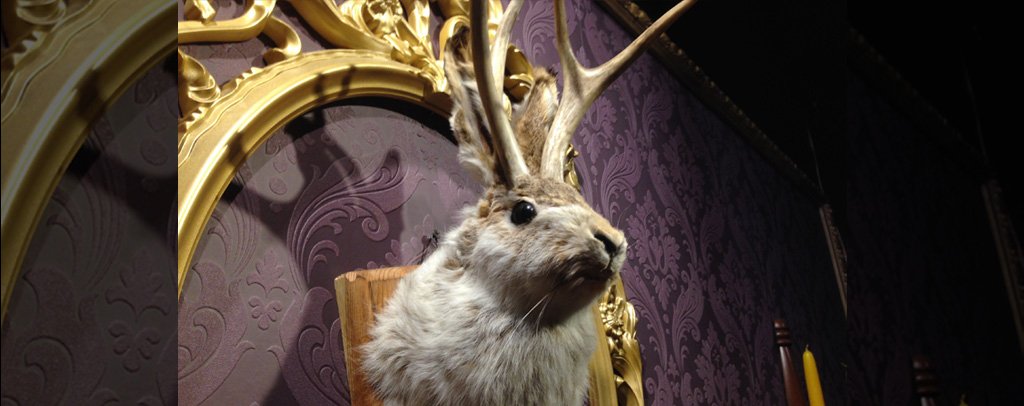
The Jackalope is an animal that looks perfectly plausible for about half a second.
Its body is that of a jackrabbit or hare, but a pair of antlers rises from its head. Western folklore has supplied the rest: Jackalopes are said to be nearly impossible to catch, capable of imitating human voices and, in especially committed versions of the joke, dangerous when cornered.
Horned rabbits are much older than Wyoming. European artwork depicted hares with horns centuries ago, and real rabbits infected with Shope papillomavirus can develop large keratinous growths around the head and face that look disturbingly like horns.
The modern American Jackalope, however, belongs to Douglas, Wyoming.
Brothers Douglas and Ralph Herrick were hunters and taxidermists who mounted antlers onto a jackrabbit and sold the resulting trophy to a local hotel during the 1930s. Even the people closest to the story disagree slightly about the date. Smithsonian, citing The New York Times, gives 1932; the City of Douglas preserves an account placing the creation in 1934. Either way, the joke worked. The Herricks began producing more of the mounts, and the horned rabbit rapidly became a western souvenir.
Douglas did not merely accept the association—it adopted the animal.
The city became known as the Home of the Jackalope, erected statues and began issuing novelty hunting licenses. The rules are appropriately useless: traditional Jackalope season falls on June 31, a date that does not exist. Local lore also supplies the creature with increasingly ridiculous habits and abilities, which is very much the point.
Unlike most creatures in an encyclopedia of legends, nobody needs to debunk the Jackalope. Its artificial origin is part of the fun. The creature survives because people know it isn’t real and keep the story going anyway.
The Herricks built a fake animal. The American West supplied it with a life.