
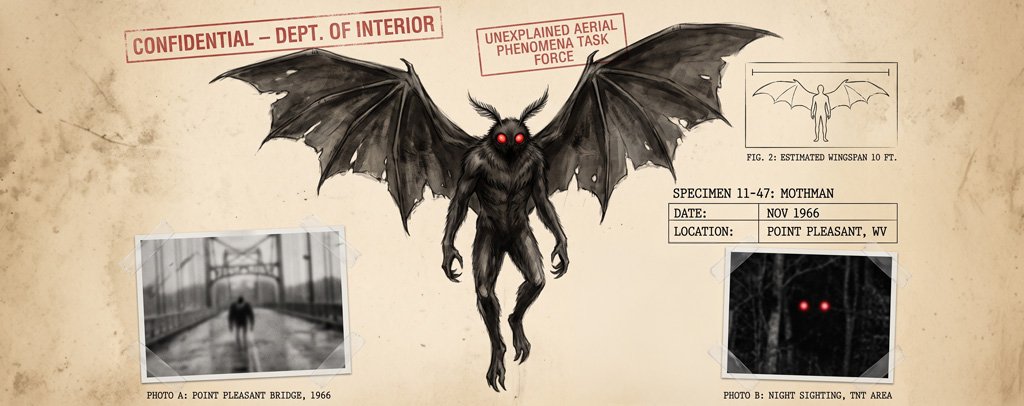
Mothman arrived suddenly.
Beginning in November 1966, people around Point Pleasant, West Virginia, began reporting a strange figure near an abandoned World War II-era munitions complex known locally as the TNT area. Witness descriptions varied, but the recurring details were hard to forget: a large humanlike shape, wings and prominent red or glowing eyes. The West Virginia Encyclopedia records 26 reports during roughly a year of concentrated sightings.
The creature was not always described as flapping through the air like a giant bird. Some witnesses said it rose almost vertically or appeared to glide. Others encountered it standing near roads, buildings or the abandoned concrete structures scattered through the TNT property. As newspaper coverage grew, Mothman became attached to an expanding collection of odd happenings that included UFO reports, malfunctioning electronics and mysterious visitors.
Writer John Keel helped turn those separate strands into a much larger mythology. His 1975 book The Mothman Prophecies connected the sightings with UFOs, Men in Black and, most famously, the collapse of Point Pleasant’s Silver Bridge.
The bridge fell into the Ohio River during rush hour on December 15, 1967, killing 46 people. Because the concentrated period of Mothman reports had occurred shortly before the disaster, later versions of the legend recast the creature as either an omen of catastrophe or a warning that nobody understood in time.
The documented cause of the bridge collapse was considerably less supernatural. The National Transportation Safety Board found that the disaster began with the failure of a suspension-chain eyebar. A flaw had grown over decades through stress corrosion and corrosion fatigue until the component fractured and the bridge failed.
No evidence ties the creature reports to the bridge collapse, and suggested explanations for Mothman sightings have included owls, large birds and especially the sandhill crane. None has ended the argument.
Point Pleasant eventually embraced its peculiar resident. Mothman is now represented by a museum, statue and annual festival, and the creature has become one of the most recognizable cryptids in the United States. What began as a remarkably concentrated group of reports in 1966 has outlived nearly everyone who witnessed the original flap.