
About Big Brutus
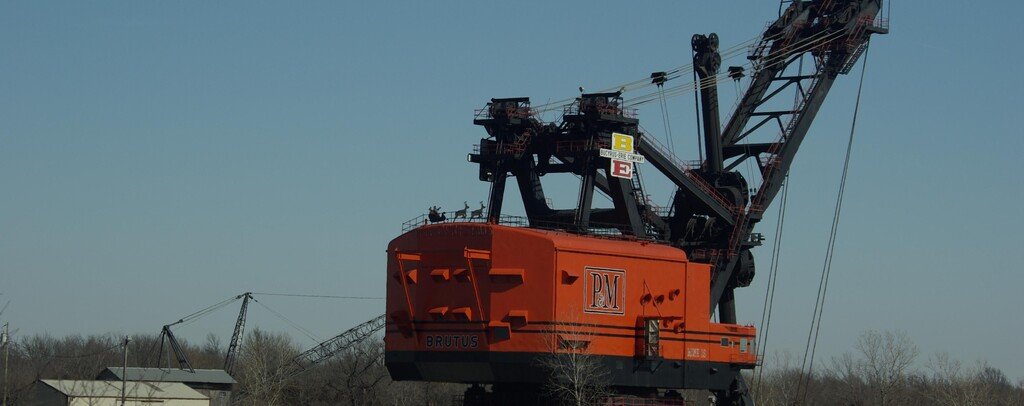
Big Brutus rises above the former coalfields of southeast Kansas like an industrial building that learned to move. The orange electric shovel stands about 160 feet tall with its boom raised and weighs roughly 11 million pounds. Its bucket could remove around 90 cubic yards of earth in one bite, exposing coal seams that smaller equipment could then reach.
The Bucyrus-Erie 1850-B stripping shovel was assembled at the mine during the early 1960s. Its pieces arrived in more than 150 railroad cars, and construction took about a year. Powered by electricity, the machine crept across the landscape on enormous crawler tracks while a crew operated its cables, motors, boom, and house-sized machinery platform.
Big Brutus worked from 1963 until 1974. When changing economics made the operation unprofitable, the shovel was shut down. Taking it apart and transporting it elsewhere would have cost too much, so the mining company left it where it stood. Local supporters later preserved the mechanical giant instead of allowing it to be cut apart for scrap.
The site became a museum dedicated to coal mining and the people who worked in the region. Visitors can walk close enough to understand the shovel’s scale, examine mining equipment, and learn how strip mining reshaped southeast Kansas. Selected interior areas allow a closer look at machinery that seems impossibly large when viewed from ground level.
Big Brutus is outside West Mineral at 6509 NW 60th Street. Admission is charged, and the museum keeps seasonal hours, so visitors should check the official website before making a long drive. The grounds also host special events and camping, while access to parts of the shovel may depend on current safety rules.
Many roadside giants are sculptures built solely to attract attention. Big Brutus earned its size by doing real work. Its extreme weight, towering boom, enormous bucket, and permanent abandonment create a rare chance to stand beside a genuine machine that was simply too big to take away.