
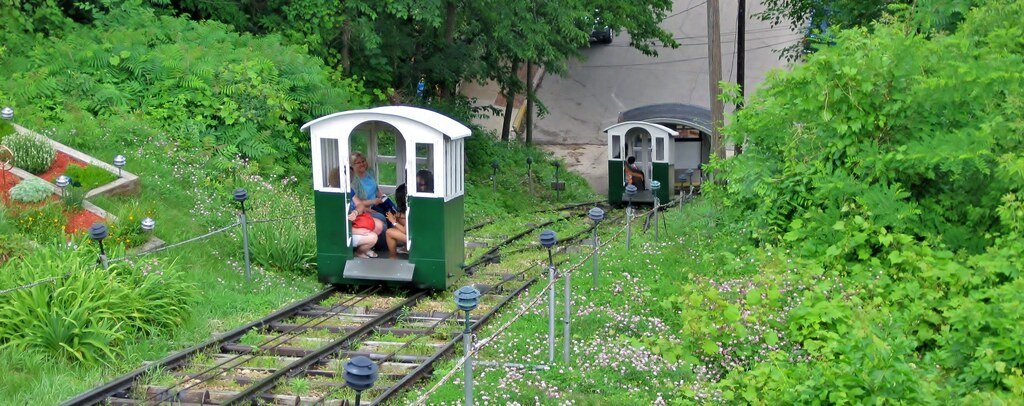
About Fenelon Place Elevator
The Fenelon Place Elevator carries passengers up a steep Dubuque bluff in two tiny counterbalanced cars. The track is only 296 feet long, yet it rises about 189 feet between Fourth Street and Fenelon Place. From below, the rails appear to climb almost directly into the neighborhood above, creating a miniature railway with the angle of an amusement ride.
The original incline was built in 1882 for J. K. Graves, a banker and former state senator. Graves wanted to travel home for lunch and a nap, but the horse-and-buggy trip around the bluff consumed too much of his break. His private shortcut used a wooden car pulled by a steam-powered winch.
Local interest persuaded Graves to open the railway to paying passengers in 1884. Fires damaged early versions of the system, and the present arrangement dates to a rebuilding in 1893. The line adopted two cars connected by cable, so the descending car helps pull the ascending car along the steep track.
Passengers enter compact enclosed cars, pass one another at a midpoint siding, and emerge at a dramatically different elevation a few moments later. The upper station provides broad views across downtown Dubuque and the Mississippi River toward Illinois and Wisconsin. The ride combines public transportation, historic machinery, and scenic lookout in a space barely longer than a city block.
The elevator operates seasonally, generally from April 1 through November 30, with posted daily hours. Adult fares are currently $2 one way and $4 round trip, with lower children’s fares. Payment is collected at the upper station, and the company does not accept credit or debit cards. Visitors should confirm current hours and bring cash.
A private solution to one man’s inconvenient lunch commute became one of Dubuque’s most distinctive landmarks. The short track, severe climb, passing cars, and hand-operated atmosphere make the Fenelon Place Elevator feel both practical and improbable, as if a backyard invention quietly became public transit.