About Albert the Bull
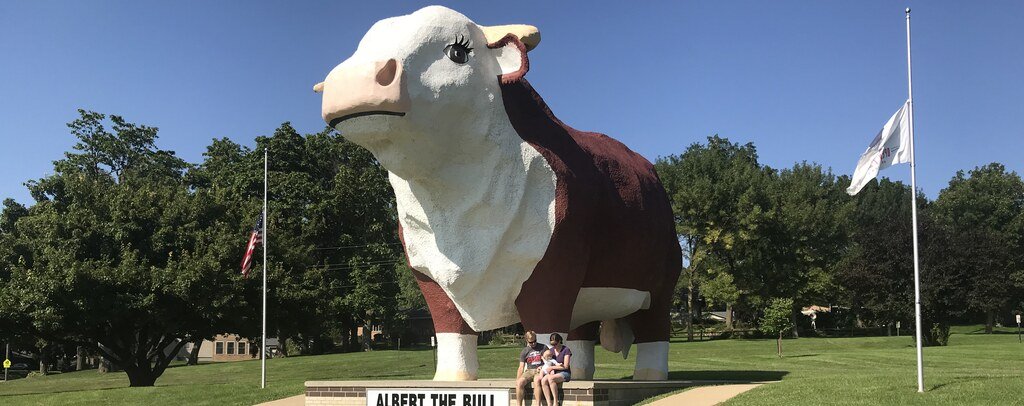
Albert the Bull stands in an Audubon park as a colossal tribute to Iowa’s cattle industry. The concrete Hereford is roughly nine times life size, about 28 to 30 feet tall, 33 feet long, and 15 feet across at the horns. Weighing an estimated 45 tons, Albert is less a statue on a pedestal than a complete piece of monumental livestock.
The idea emerged during the early 1960s as local leaders looked for a symbol of the area’s beef production. Audubon’s Jaycees organized the project, and the enormous bull was completed in 1964. Steel salvaged from old Iowa windmills formed part of the internal framework before layers of concrete gave the sculpture its unmistakable shape.
Albert is painted in the red-and-white pattern of a Hereford. Covering the huge body once required about 65 gallons of paint. Details that would be small on a real animal become oversized landmarks here, from the broad muzzle and heavy hooves to the long horns and remarkably visible anatomy beneath the statue.
A nearby kiosk allows Albert to speak to visitors and explain his story. The recorded narration adds personality to an object already treated as a local celebrity. Residents have maintained, repainted, and promoted the bull for decades, making him a durable civic mascot as well as a roadside photo stop.
Albert stands at Albert the Bull Park on East Division Street. The outdoor statue is free to view, and the surrounding park includes recreation and camping facilities. Access to particular amenities may vary by season, but the bull itself can be appreciated quickly from the grounds without entering a building.
Giant roadside animals are rarely subtle, and Albert makes no attempt to be. His mass, realistic pose, and farm-country setting turn a familiar Iowa subject into something gloriously excessive. The result is both a sincere agricultural monument and a concrete bull large enough to dwarf the people beneath it.