
About Snake Alley
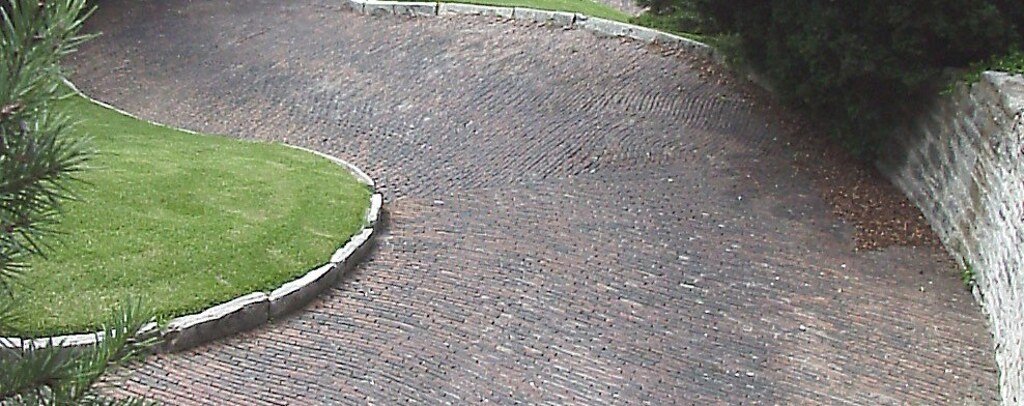
Snake Alley curls up Burlington’s Heritage Hill in a compact series of switchbacks paved with brick. The one-block street contains five half-curves and two quarter-curves within about 275 feet. It rises more than 58 feet from Washington Street to Columbia Street, producing a grade of roughly 21 percent and enough turning to make the road look folded into the hillside.
The street was conceived by local German immigrants who were familiar with the winding vineyard paths of Europe. City engineer William Steyh designed the route, and contractor George Kriechbaum helped build it in the 1890s. Its limestone curbs and blue-clay bricks were arranged to manage the constantly changing slope and give horses better footing on the difficult descent.
Snake Alley was intended as a practical connection between downtown Burlington and homes above the bluff. Its sharp bends quickly became the greater attraction. The street eventually gained its serpentine nickname, and Robert Ripley helped popularize it as an exceptionally crooked road. Its curves are tighter than those of San Francisco’s better-known Lombard Street.
Drivers may descend the one-way street when it is open, but the best way to understand its shape is on foot. From the bottom, the brick road seems to disappear and return between retaining walls, gardens, and historic houses. Each curve tilts differently, revealing the complicated geometry required to build a road across such a steep slope.
The alley is outdoors and free to visit. It lies on North Sixth Street between Washington and Columbia Streets. Traffic conditions and seasonal closures can change, so visitors should obey signs, watch for vehicles, and avoid blocking residents. Burlington also uses the hill for annual events, including a demanding bicycle race.
This is not merely a curvy street with a catchy name. It is a nineteenth-century engineering solution that became stranger as the road climbed. The handmade brick surface, severe grade, and repeated turns create a miniature mountain pass in the middle of an Iowa neighborhood.