
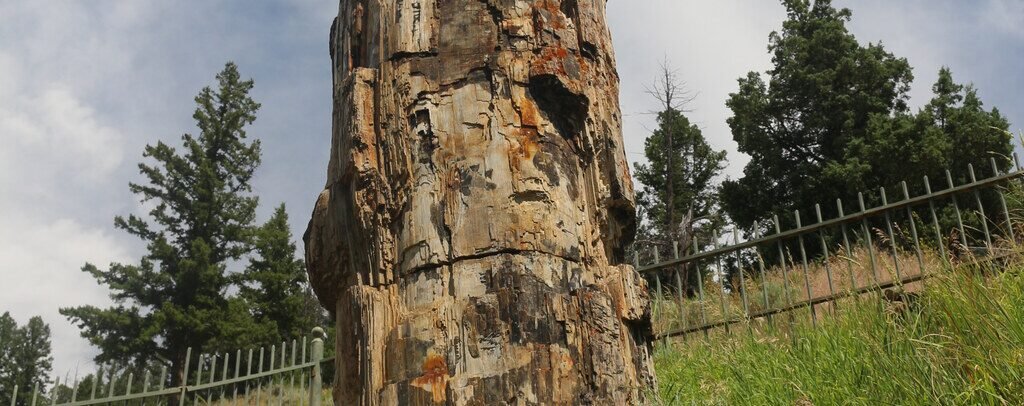
About Petrified Tree
Yellowstone’s Petrified Tree looks like the shattered trunk of an ordinary redwood, but it has been standing in stone for roughly 50 million years. The upright fossil is a remnant of the ancient forests that once covered the region during the Eocene Epoch.
Volcanic eruptions repeatedly buried trees beneath ash, mud, and debris. Mineral-rich groundwater seeped through the buried wood and gradually replaced its organic structure with stone. The process preserved growth rings, bark patterns, and other details while transforming the trunk into rock.
Early visitors found several upright petrified trees at this location. Souvenir hunters chipped away at them until only one prominent trunk remained. A protective fence now surrounds the survivor, an odd reminder that a stone tree can still be damaged by people.
The single roadside trunk is only a visible fragment of Yellowstone’s much larger fossil forests. Specimen Ridge contains multiple layers of petrified trees, leaves, pollen, and other evidence of ancient ecosystems stacked within volcanic deposits.
Why it’s weird: A redwood-like tree was buried by volcanic debris, turned into solid stone molecule by molecule, and remains upright tens of millions of years after the forest disappeared.
Visitor info: Petrified Tree is reached by a short spur road near Tower Junction in Yellowstone National Park. Roads may close seasonally, and visitors must remain outside the protective fence.