
About Boar’s Tusk
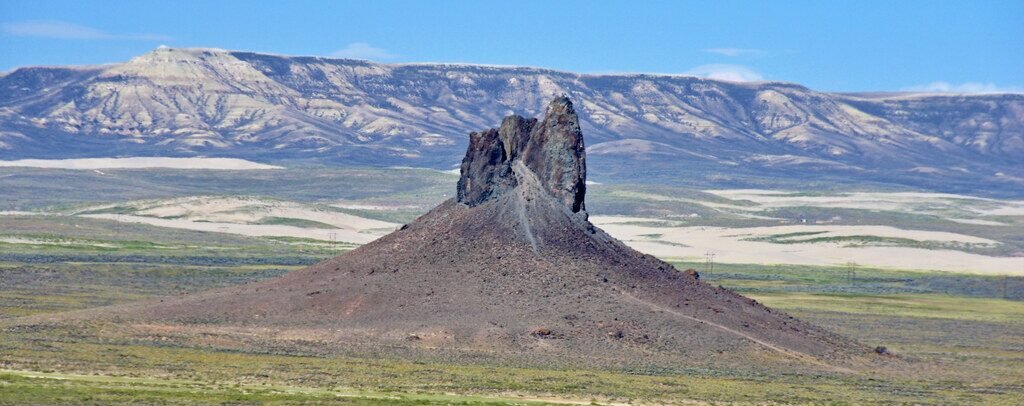
Boar’s Tusk rises abruptly from the flat expanse of Wyoming’s Red Desert like a broken stone fang. The isolated formation stands about 400 feet above the surrounding Killpecker Creek plain and is visible for miles.
The spire is the hardened core of a volcano that erupted roughly 2.5 million years ago. Wind and water slowly stripped away the softer outer cone, leaving behind the resistant volcanic neck. Its rock is a rare variety of lamproite known as wyomingite, a name tied directly to the unusual geology of the region.
For Indigenous travelers, pioneers, railroad crews, ranchers, and modern hikers, the Tusk has served as a natural landmark in a landscape where distances can be difficult to judge. It appears almost artificial from far away because there is little nearby terrain to explain its sudden vertical shape.
The surrounding area is remote public land reached by rough desert roads. High-clearance or four-wheel-drive vehicles may be necessary, especially after rain, when clay roads can become impassable.
Why it’s weird: What looks like a solitary stone tooth is actually the exposed throat of a long-eroded volcano made from an uncommon rock strongly associated with Wyoming.
Visitor info: Boar’s Tusk is north of Rock Springs near the Killpecker Sand Dunes. Carry water, navigation, emergency supplies, and current Bureau of Land Management maps.