
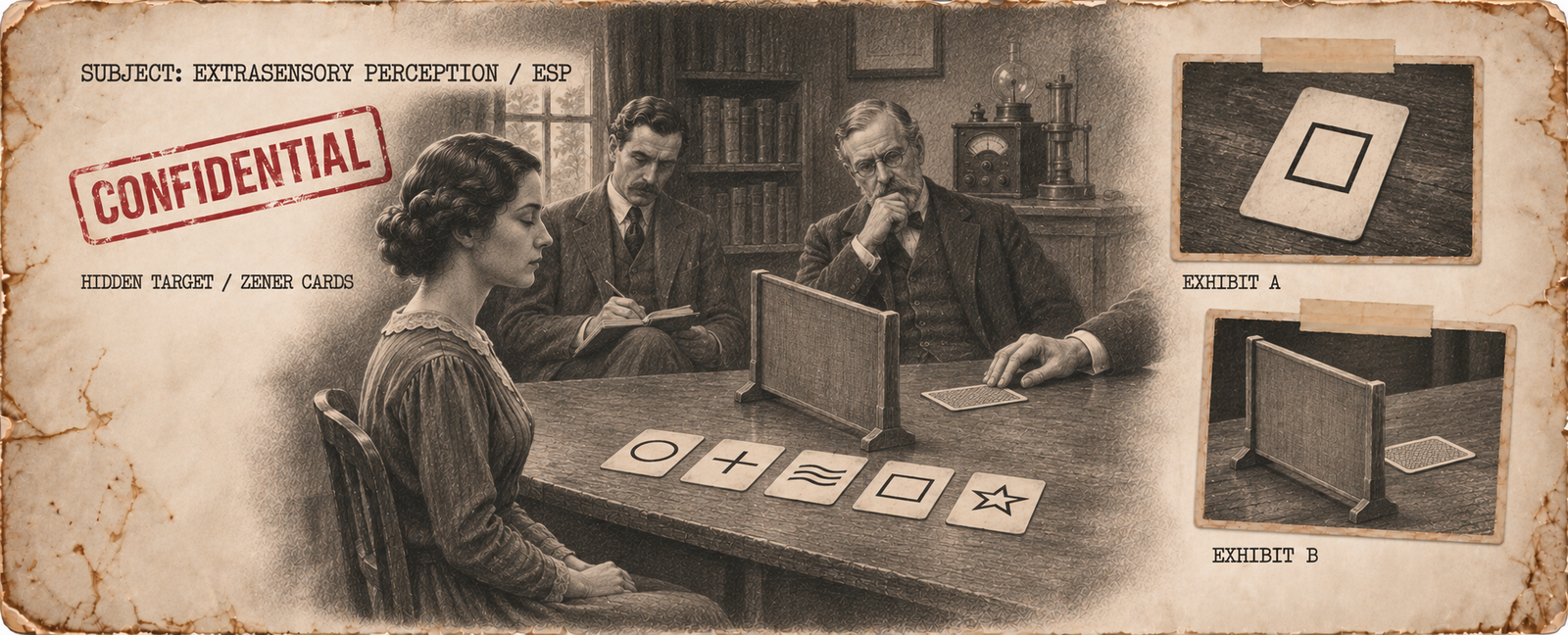
Extrasensory perception, or ESP, is a broad term for the claimed acquisition of information without using the recognized sensory channels. The category commonly includes telepathy, clairvoyance, and precognition. J. B. Rhine and Louisa Rhine helped make ESP a laboratory research subject after joining Duke University, where a Parapsychology Laboratory operated from 1930 for roughly three decades.
One iconic method used decks of cards containing a small set of symbols designed by psychologist Karl Zener. Participants attempted to identify concealed cards or targets, and researchers compared the number of hits with chance expectation. Rhine’s publications and Duke’s laboratory helped shift psychical research away from séance rooms toward statistics, repeated trials, controlled targets, and experimental design. The term ESP became part of popular culture as a result.
The evidence remains heavily disputed. Some meta-analyses of ganzfeld and related experiments have reported above-chance effects, while other analyses and replication efforts have failed to confirm them or argued that randomization, publication bias, missing studies, and methodological variation can inflate the results. A 1999 meta-analysis of thirty stringent ganzfeld studies failed to reproduce an earlier claimed effect. Later statistical reanalyses and pro-psi reviews have argued for residual evidence. The central scientific problem remains independent, reliable replication.
Evidence and interpretation
ESP research, Rhine’s Duke laboratory, Zener-card testing, and decades of experiments are documented. Findings remain contested, and ESP is not an established sensory ability accepted across mainstream psychology.