
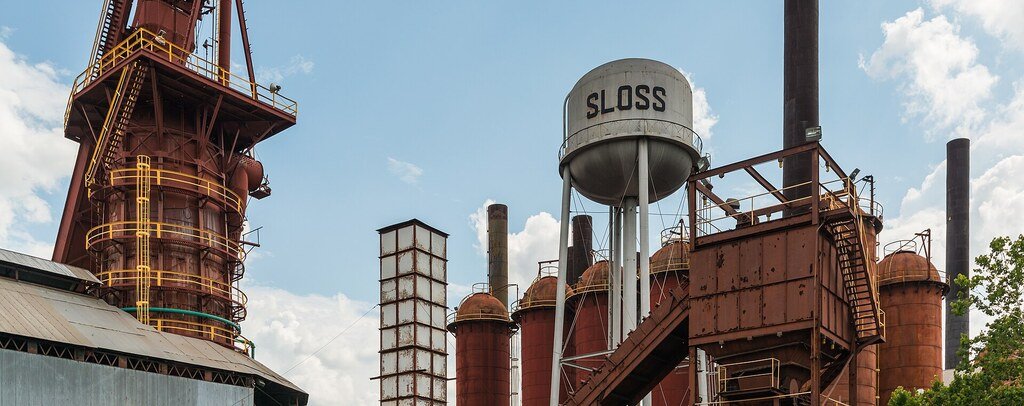
About Sloss Furnaces
Just east of downtown Birmingham stands a sprawling industrial labyrinth of rust-colored pipes, towering stoves, massive furnaces, and machinery built to operate under punishing heat. Sloss Furnaces produced pig iron for nearly ninety years. Instead of being demolished after it closed, the complex was preserved as a public museum,allowing visitors to walk through one of America’s most complete surviving blast-furnace sites.
Colonel James Withers Sloss founded the Sloss Furnace Company in 1881, shortly after Birmingham emerged as a center of railroads and heavy industry. The site’s first blast began in April 1882. During its initial year, the plant produced approximately 24,000 tons of iron, using the region’s nearby deposits of iron ore, coal, and limestone.
The furnaces changed repeatedly as new owners expanded and modernized the operation. Boilers, blowers, gas-cleaning equipment, and rebuilt furnace sections transformed the property into a dense network of specialized structures. At its height, the company operated mines and quarries across the Birmingham district and ranked among the region’s largest iron producers.
Sloss closed in 1971 as aging equipment, changing markets, and modern air-quality requirements made continued production impractical. Demolition appeared likely, but preservationists argued that the complex represented the industry responsible for Birmingham’s existence. Voters approved public funding to stabilize the property, and Sloss opened as a museum in 1983. It remains the only twentieth-century blast furnace in the United States preserved for public interpretation.
The site now hosts self-guided tours, metal-arts programs, concerts, festivals, and special events. Its enormous machinery, dark passageways, and stories of dangerous working conditions have also inspired persistent ghost tales and nighttime paranormal tours.
Sloss Furnaces is unusual because an entire obsolete factory became the exhibit. There are no tidy reproductions separating visitors from the past,the furnaces, stoves, pipes, and platforms are the museum. The result feels like a preserved mechanical city built for fire, smoke, and molten iron.