
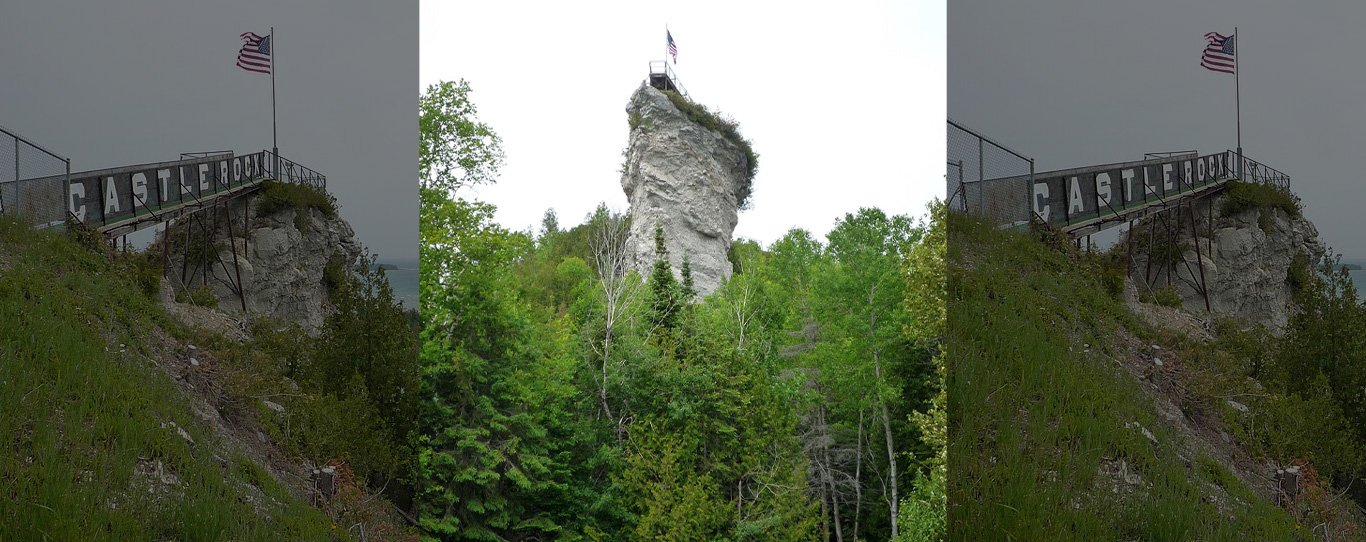
About Castle Rock
Castle Rock is a striking limestone formation located just north of St. Ignace on Michigan’s Upper Peninsula. Rising approximately 195.8 feet above the surrounding landscape, the towering rock is a natural geological formation that has been transformed into a classic roadside attraction.
The formation was created through erosion following the Wisconsinan glaciation. As the enormous prehistoric ice sheets retreated, the resulting meltwater helped form ancient Lake Algonquin, whose waters were considerably higher than those of modern Lake Huron. Over time, erosion wore away the surrounding limestone landscape. Castle Rock resisted that erosion, leaving behind the tall, isolated formation visible today.
Geologically, Castle Rock is a limestone breccia sea stack, sometimes described as a sea chimney. Its unusual appearance places it in the same broad geological family as formations such as Arch Rock and Sugar Loaf on nearby Mackinac Island. What makes Castle Rock particularly interesting is the way a natural geological formation has been incorporated into a century-old tourist attraction.
The site became a public attraction in 1928, when C. C. Eby purchased Castle Rock and an adjacent tourist stand. The Eby family has continued to own and operate the attraction ever since, making Castle Rock a rare example of a roadside destination maintained by the same family for generations.
Visitors can climb an outdoor staircase carved into the side of the formation to reach the summit. From the top, the elevated viewpoint provides sweeping views across the surrounding Upper Peninsula and Lake Huron, including views toward the Mackinac Bridge. The climb itself is part of the experience, with steep stairs leading upward through the exposed limestone formation.
Castle Rock’s roadside character is reinforced by the enormous statues of Paul Bunyan and Babe the Blue Ox standing near the entrance. The legendary lumberjack and his companion have become familiar symbols of northern Michigan tourism, while the adjacent gift shop adds another traditional element of the classic roadside attraction.
The site has also accumulated local stories and legends. Castle Rock has been promoted as “Ojibway’s Lookout,” although the nearby hill known as Rabbit’s Back is considered more likely to have served as the actual lookout point. The distinction illustrates how natural landmarks can acquire layers of folklore and interpretation over time.
Today, Castle Rock remains a seasonal tourist attraction and one of the Upper Peninsula’s more unusual combinations of natural wonder and roadside Americana. It offers visitors the chance to climb a geological formation, take in a remarkable view, and encounter giant figures from American tall-tale folklore—all at the same roadside stop.