
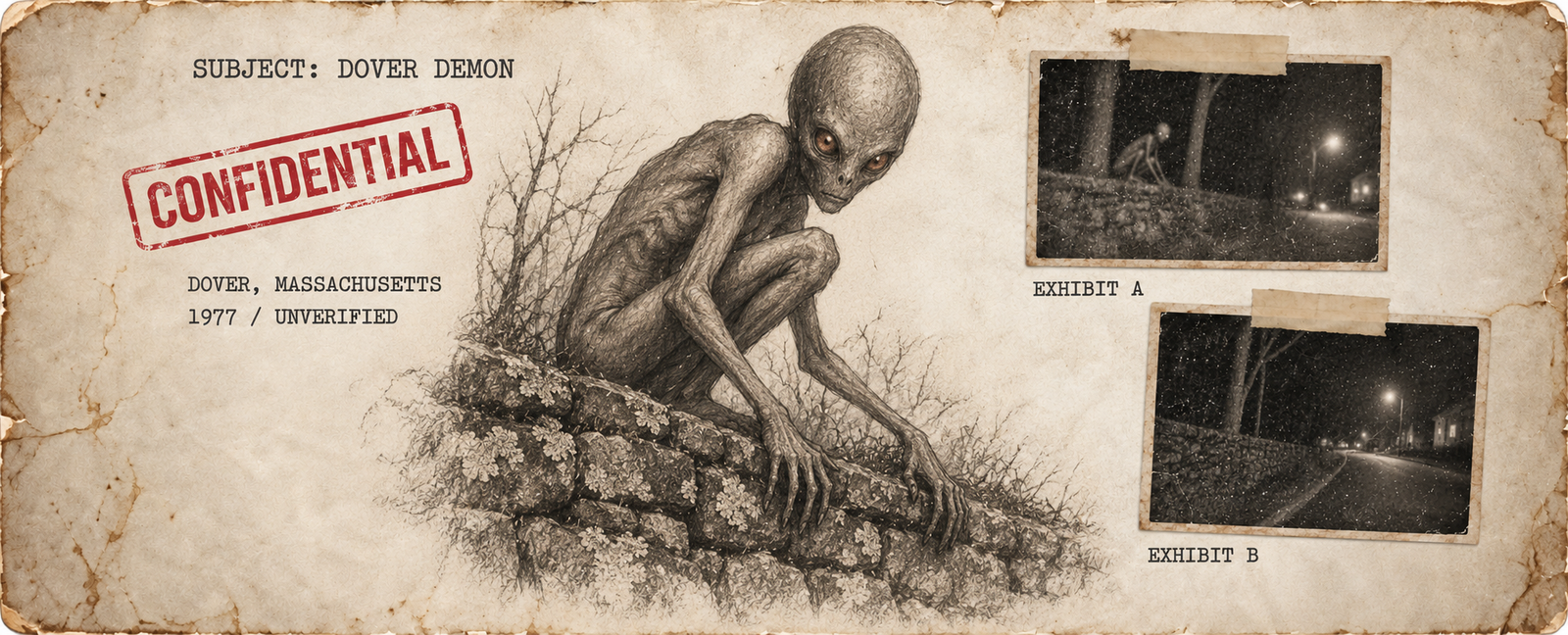
The Dover Demon legend comes from a compact series of reports in Dover, Massachusetts, on April 21 and 22, 1977. Seventeen-year-old Bill Bartlett said he was driving on Farm Street when his headlights illuminated a strange figure perched or crouched near a stone wall. He described an unusually large oval or watermelon-shaped head, a thin body, long limbs, and large bright eyes.
Other teenagers reported seeing a similar figure during the following hours, including John Baxter near Miller Hill Road and Abby Brabham the next night. The witnesses made drawings, and the similarities between some of those sketches became central to the case’s reputation. The name “Dover Demon” was applied afterward by investigator Loren Coleman and helped turn a short-lived local incident into a recognized New England cryptid.
No physical trace, photograph, hair, track cast, or body was recovered. Suggested explanations have included a foal, young moose, unusual dog, owl, prank, or perceptual error, but no single explanation has been demonstrated from the surviving evidence. Later retellings sometimes exaggerate the number of sightings or make the creature sound more alien than the original descriptions justify. The April 1977 witness reports and sketches remain the core historical record.
Evidence and claims
The named witnesses, dates, later interviews, and original witness drawings are documented. The identity of what they saw was never established, and no physical evidence confirms an unknown animal.
Sources
- bostonglobe.com — Boston Globe summary of the 1977 sightings, Bartlett’s description, the other witnesses, and the resulting sketches.
- bostonglobe.com — Boston Globe overview placing the Dover Demon among unresolved Massachusetts stories.
- projectunredacted.com — Source-oriented collection identifying witness sketches, interviews, and contemporary press coverage. Use the underlying historical references rather than its interpretive conclusions.