
About Grotto of the Redemption
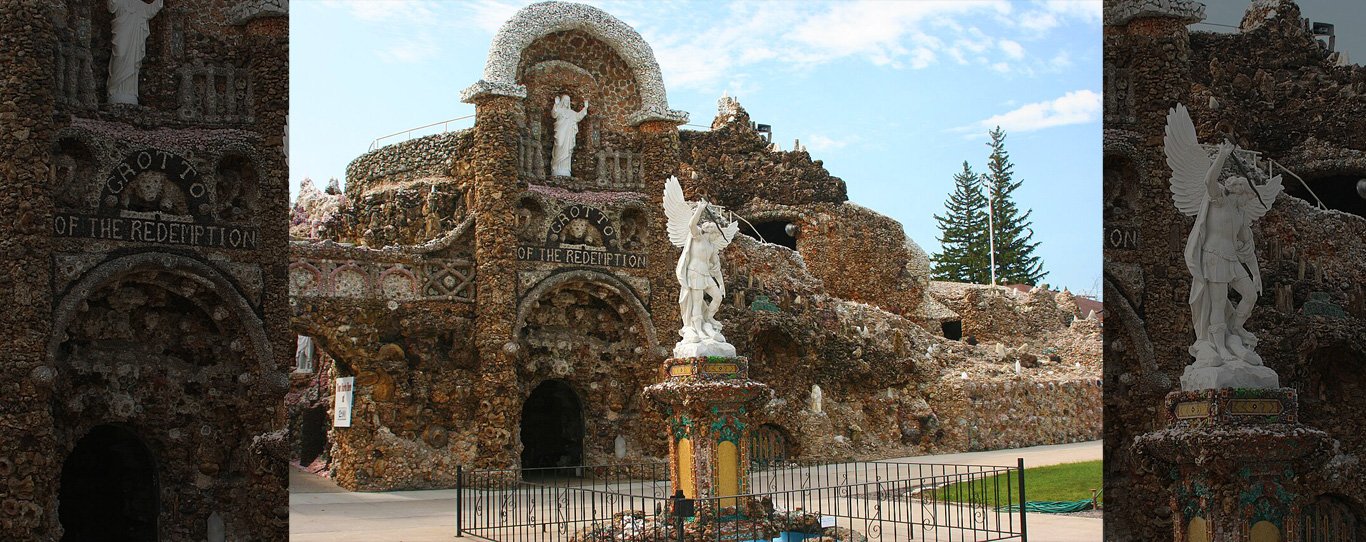
The Grotto of the Redemption is a remarkable religious shrine located in West Bend, Iowa. Covering an entire city block and constructed from an estimated collection of precious and semi-precious stones, the grotto is widely regarded as one of the largest man-made grottos in the world. Part religious monument, part folk-art masterpiece, and part geological museum, it stands as one of the Midwest’s most unusual attractions.
The grotto was the life’s work of Father Paul Matthias Dobberstein, a German-born Catholic priest who immigrated to the United States in the late nineteenth century. According to local tradition, Dobberstein became seriously ill as a young man and prayed for recovery, promising to dedicate his life to honoring the Virgin Mary if he survived. After recovering, he eventually settled in West Bend and began work on what would become his monumental project.
Construction started around 1912 and continued for more than four decades. Dobberstein, assisted by Father Louis Greving and numerous volunteers, carefully assembled vast quantities of minerals, fossils, petrified wood, crystals, shells, and gemstones into elaborate structures depicting scenes from Christian history. The collection includes materials gathered from across the United States and around the world, creating a colorful and highly detailed artistic landscape.
Visitors exploring the grotto encounter a series of interconnected shrines, chapels, arches, and religious scenes. Biblical events are represented through intricate stonework, while pathways wind through towering formations covered in sparkling minerals. The sheer variety of materials is astonishing, ranging from quartz and agates to geodes, amethysts, and fossil specimens.
What makes the Grotto of the Redemption especially fascinating is the combination of faith, art, and geology. Rather than using traditional building materials alone, Dobberstein transformed natural specimens into architectural elements, creating an environment that feels both sacred and otherworldly. The result is unlike any conventional church or shrine.
Over the decades, the grotto became a major pilgrimage site and tourist destination. Visitors arrive not only for its religious significance but also to admire the craftsmanship and scale of the project. The attraction continues to be maintained and preserved, ensuring that future generations can experience one of America’s most extraordinary examples of visionary architecture.
Today, the Grotto of the Redemption remains a testament to perseverance, devotion, and creativity. It is a place where millions of stones tell a story that spans faith, art, and the natural world.