
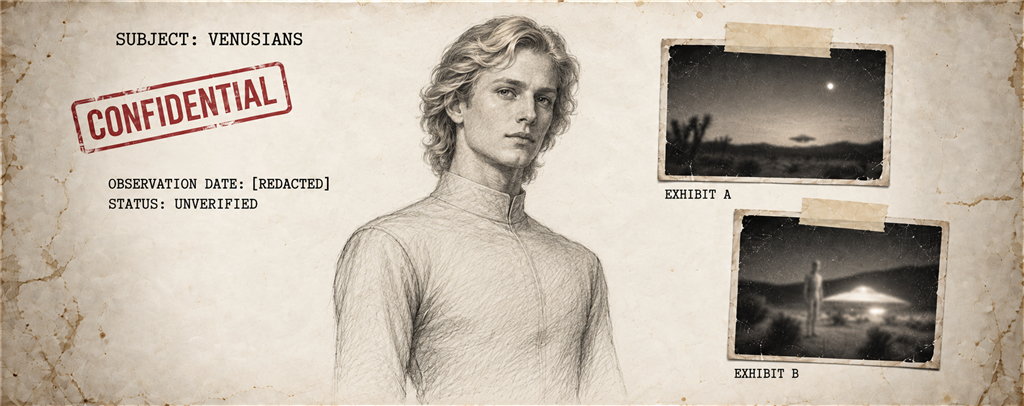
Venusians were among the most prominent supposed extraterrestrials in the contactee stories of the early 1950s. George Adamski established the best-known version after claiming that on November 20, 1952, he met a humanlike occupant of a landed spacecraft in the California desert. Adamski said the visitor came from Venus, and his 1953 book Flying Saucers Have Landed brought the account to an international audience. The reported being was attractive and human in appearance, establishing a model that became closely associated with the wider Space Brother archetype.
Adamski’s success encouraged a wave of contactee accounts. Howard Menger, for example, publicly described encounters with beautiful humanlike visitors and later claimed to have traveled aboard a Venusian craft. Other UFO groups and contactees likewise named Venus as the origin of supposed visitors. These stories reflected an early period of UFO culture when nearby planets were still popular settings for extraterrestrial civilizations in public imagination. The visitors were generally portrayed as communicative and humanlike, sharply contrasting with later abduction accounts involving unfamiliar interiors, involuntary examinations, and Grey Aliens.
Astronomy eventually made the literal Venusian claim increasingly difficult to sustain. Spacecraft observations revealed a planet with crushing atmospheric pressure, extreme surface temperatures, and conditions incompatible with unprotected humanlike life. UFO lore adapted rather than disappearing, and later contact traditions increasingly placed humanlike visitors around distant star systems such as the Pleiades. Historically, Venusians are therefore valuable as a snapshot of the first great contactee era and as a predecessor to later Nordic and Pleiadian archetypes. These contactee accounts do not establish the existence of Venusian visitors.
Evidence and claims
Adamski, Menger, and others publicly claimed Venusian contact. Their claimed extraterrestrial meetings were never independently verified.
Sources
- encyclopedia.com — Supports Adamski’s 1952 Venusian claim and influence.
- encyclopedia.com — Supports the early contactee movement and the Venusian visitor story.
- encyclopedia.com — Supports additional Venusian contactee claims.