
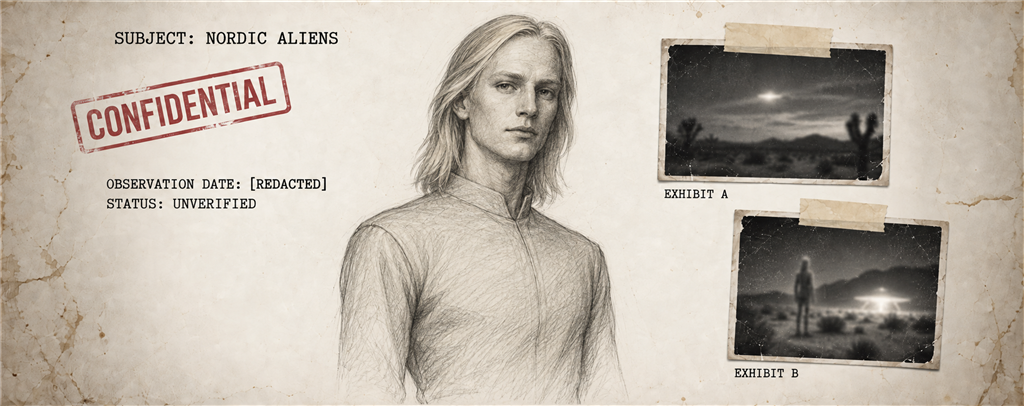
Nordic aliens are human-looking extraterrestrials associated with the contactee movement that flourished during the 1950s. Reports and contactee literature commonly described unusually attractive, tall, fair-haired visitors who could pass for human. The broader contemporary term "Space Brothers" covered a wider range of supposedly benevolent extraterrestrial visitors, but the two ideas overlap heavily. George Adamski became the most influential early figure after claiming that he met a humanlike visitor from Venus in the California desert on November 20, 1952. His widely read accounts helped establish the friendly humanoid visitor as a major UFO archetype.
Adamski was followed by numerous other contactees who claimed meetings, conversations, or rides aboard spacecraft. Their stories generally differed from the frightening abduction narratives that became prominent decades later. The visitors tended to communicate voluntarily, appeared physically attractive and recognizably human, and were described as technologically advanced. As contactee literature spread, the broad Space Brother image gradually developed into more specific extraterrestrial identities, including Venusians and later Pleiadians. This makes "Nordic alien" less a single documented entity than an evolving category within modern UFO storytelling.
By the 1980s and 1990s, American alien imagery increasingly emphasized Grey Aliens, abduction procedures, secret programs, and more threatening encounters. The earlier Space Brothers remained part of UFO culture but became less dominant. The modern label "Nordic alien" also tends to impose a standardized appearance on accounts that originally varied considerably. Nordics are best understood as a historical UFO archetype; human-looking figures in contact literature do not establish one consistent species.
Evidence and claims
Contactee books and public claims about human-looking extraterrestrials are well documented. No reliable evidence establishes that the described visitors were extraterrestrial beings or members of a single species.
Sources
- encyclopedia.com — Supports the early contactee movement and Adamski’s reported 1952 encounter.
- encyclopedia.com — Supports Adamski’s role in establishing the contactee model.
- books.google.com — Supports historical context for changing UFO and alien narratives.