
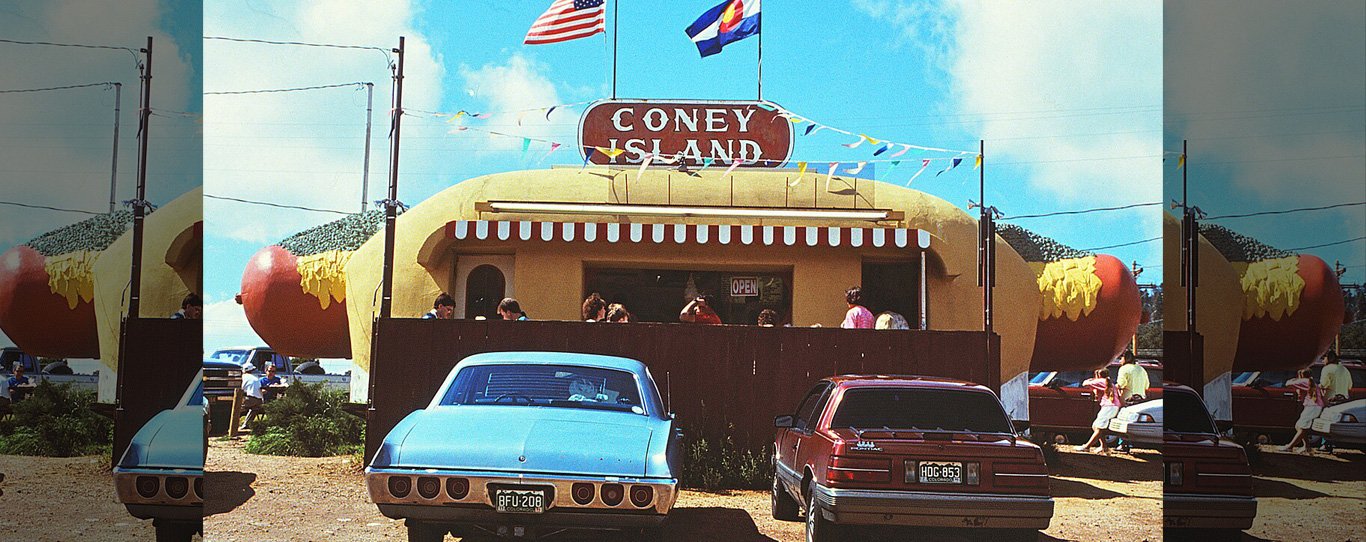
About Coney Island Hot Dog Stand
The Coney Island Hot Dog Stand in Bailey, Colorado, is a classic example of programmatic architecture—a style of building design where the structure itself resembles the product being sold. In this case, the restaurant is literally a giant hot dog. Complete with a bun, mustard, and toppings, the whimsical building has become one of Colorado’s most recognizable roadside oddities.
The stand was originally constructed in 1966 on Denver’s Colfax Avenue under the name The Boardwalk at Coney Island. Its creator, Marcus Shannon, envisioned a chain of hot dog restaurants built around the distinctive giant-hot-dog design and even obtained a patent for the concept. Unfortunately, the larger chain never materialized, and the original restaurant closed after only a few years.
Rather than disappearing, the giant hot dog began an unusual journey across Colorado. In 1970, new owners moved the structure to Aspen Park along U.S. Highway 285, where it operated for decades under the name Coney Island Dairy Land before eventually shortening its name to simply Coney Island. The building became a beloved local landmark, attracting travelers, families, and roadside architecture enthusiasts.
When the property was slated for redevelopment in the early 2000s, local residents rallied to save the giant hot dog from demolition. The campaign succeeded, and in 2006 the entire structure was transported approximately 17 miles down Highway 285 to its current home in Bailey, near Pike National Forest. The move preserved one of Colorado’s most distinctive roadside attractions and ensured its continued survival.
The building itself is impressive in scale. The bun measures roughly 35 feet long, while the hot dog extends about 42 feet. The entire structure weighs approximately 18 tons, making it far more than a simple novelty sign. It is a fully functioning restaurant housed inside a giant hot dog.
Today, the Coney Island Hot Dog Stand remains a popular stop for travelers heading into Colorado’s mountains. It serves as both a restaurant and a living reminder of the golden age of roadside attractions, when businesses competed for attention with giant sculptures, unusual architecture, and unforgettable designs. Its enduring popularity has even earned appearances in documentaries, comics, and popular culture.