
About World’s Largest Rubik’s Cube
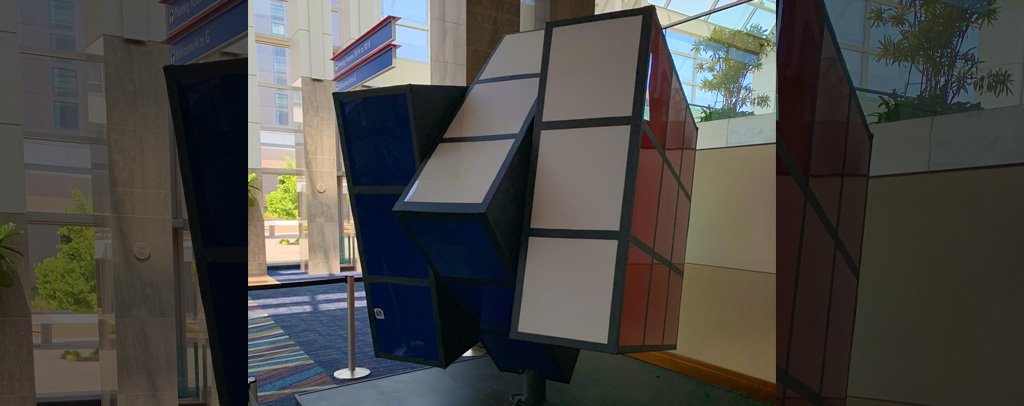
Knoxville owns a Rubik’s Cube that is approximately ten feet tall and weighs about 1,200 pounds. It was created for the 1982 World’s Fair, displayed at the Hungarian pavilion, and given to the city by Hungary. Decades later, the giant puzzle still survives inside the Knoxville Convention Center.
Calling it a Rubik’s Cube creates an important expectation: cubes are meant to turn. This one was built as more than a static colored box and became one of the oversized novelty objects associated with the fair. At full scale, each familiar colored square becomes an enormous panel, and the complete object looks less like a handheld puzzle than a piece of machinery disguised as a toy.
The cube is part of Knoxville’s surprisingly durable collection of World’s Fair leftovers. Outside the convention center, the gold Sunsphere still dominates World’s Fair Park. Inside, the huge cube preserves a more playful part of the same event, when countries and exhibitors competed for attention with technology, architecture, displays, and objects engineered to be unforgettable.
The normal Rubik’s Cube is small enough to scramble with two hands and frustrating enough at that size. Knoxville’s version transforms the same design into a 1,200-pound object that would require a very different approach to solving it. It is less a desk puzzle than a monument to the period when making something ten feet tall was considered an entirely reasonable way to represent a nation at a world’s fair.