
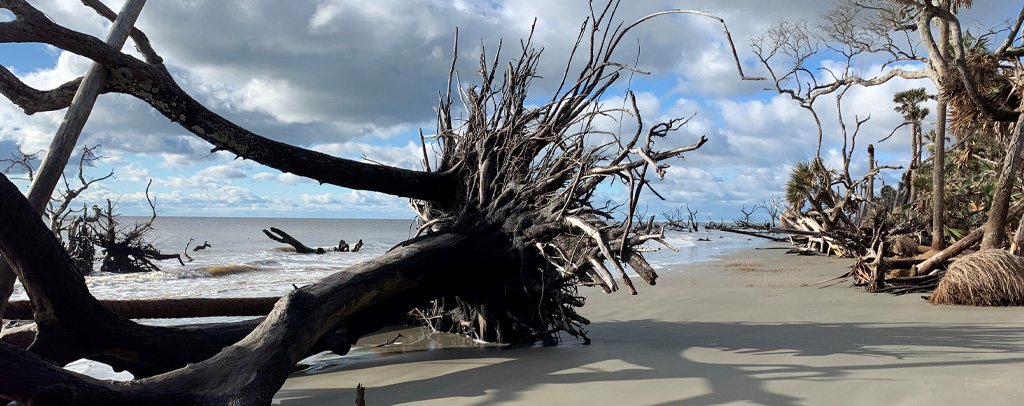
About Boneyard Beach
Boneyard Beach looks like a forest died in place and the ocean kept moving through it.
The shoreline occupies roughly three miles along the northeastern side of Bulls Island in Cape Romain National Wildlife Refuge. Erosion has eaten into what was once maritime forest, toppling oaks, cedars, pines, and other trees onto the beach. Sun and salt bleach the exposed wood until trunks and branches resemble enormous scattered bones.
The landscape continues to change. Trees fall, sand shifts, tides expose different sections of shoreline, and the Atlantic keeps moving inland. The result is not a landscaped attraction or an art installation. It is a visible record of a barrier island being rearranged by the coast.
Bulls Island has no road connection to the mainland. Visitors normally arrive by passenger ferry or private boat, then hike across the island to the beach. The refuge is day use only, and tide, weather, insects, wildlife, and ferry schedules all matter. Check the U.S. Fish and Wildlife Service before making the trip.